

Download StuCred.
The Real Time Student Credit App.

Instant Student Loan in India — Complete Guide to Fast Approval, Eligibility, Documents & Best Lenders
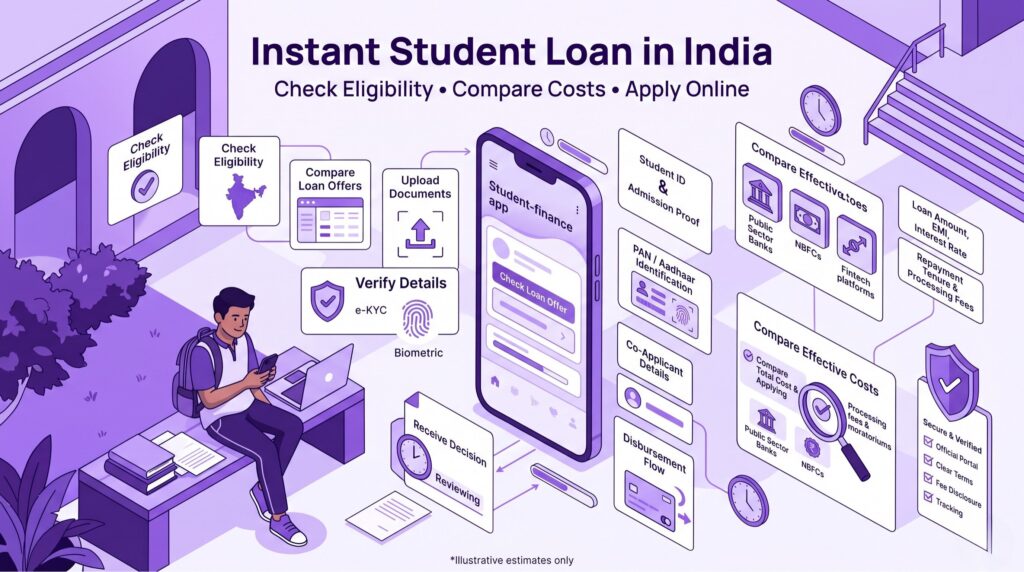
When the clock ticks down to the academic deadline, you need to get in or miss a course entirely. Getting the right options in fast-track mode and knowing how much documentation is required can be instrumental. This guide takes you through: What does instant mean for education finance in India; who are these products suitable for; eligibility & credit requirements; documents needed for quick approval Product types: Banks, NBFCs or fintech Interest and fees Step by step application advice to secure funds between 24–72 hours, Risk management Compare different lenders on an explained framework: Which one is best? FAQs: Credibility signals. Final Next Steps. This will act as your operating list when getting an instant loan for tuition fee payments, hostel expenses, coupled with admission deposits or urgent educational costs faster and with less friction.
Read more
What is an Instant Student Loan?
Definition and how “instant” differs from regular education loans
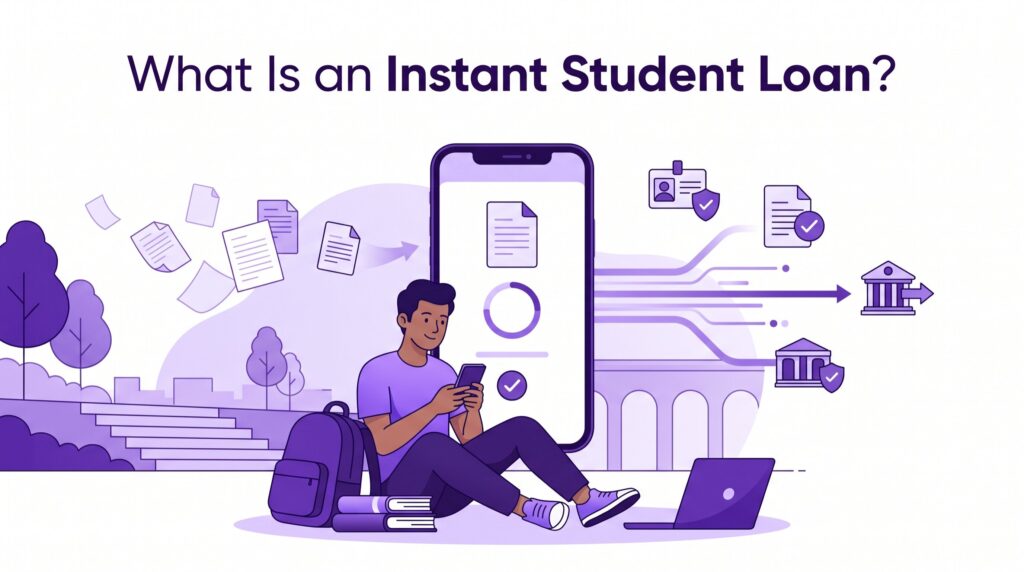
Instant student loan: A credit product that disburses within an hour to cover urgent education-related financial needs arising at short notice — typically for payment of tuition or admission deposit; proofs required for expenses to meet immediate exigency. Instant loans focus on speed (streamlined documents, quick/auto-verifications like Aadhaar OTP and bank statement parsing, pre-approved limits or simplified underwriting), whereas conventional education loans have longer processing timelines (in several days to weeks).
But “instant” is a relative concept: lenders may boast same-day approvals and disbursals, but mostly the magic involves limiting loan size, which is possible only with clean digital documents, or approval of unsecured short-term credit. In traditional bank education loans, loan amounts and tenure are high, but the process takes a long time due to physical credit checks, collateral verification and property valuation.
Situations where instant loans are useful
Tuition deadlines: A non-negotiable fee deadline at a college or university (or seat deposit that would be forfeited in an emergency).
Hostel and mess charges: Immediate payment for getting the campus accommodation.
Foreign admission deposits and visa proofs: Many foreign universities ask for deposits or proof of funds quickly; instant loans can provide documentary proof or funds for payment.
Emergency shortfall: Fluctuation of money suddenly, scholarship not being in order or lose a job by parents.
Bridge funding: Good when waiting for scholarship disbursal, employer sponsorship, or education loan sanction for a longer duration.
Types of instant student loans available in India
Education OD: Bank overdrafts. Existing customers can avail an overdraft against fixed deposits or salary relationships—Quick for pre-approved customers.
Personal loan for education (Unsecured nature): Disbursed immediately; suitable for lower amounts and generally carrying higher interest compared to dedicated education loans.
NBFC education loans: Non-bank finance companies that focus on education lending often provide the advantages of comparatively fast processing, more flexible collateral stipulations and competitive loan disbursal rates.
Fintech instant loans: App-based consumer lending gives small-ticket instant loans secured via automatic KYC, e-signatures and bank statement scraping for almost immediate approvals.
Typical turnaround times claimed vs realistic timelines in India
Claimed: When lenders claim they give approvals within minutes to 24 hours and disbursal within 24–72 hours.
Realistic: Many applicants can get sanction in hours and money in 24–48 hours for fully digital, pre-approved offers or small unsecured loans. Secured loans, higher-value mortgages and cases where co-borrower underwriting is required can take multiple days or even a couple of weeks to turn around due to verification of documents, valuation and/or compliance checks.
Important elements governing timeline: documents are complete and full, prior relationship with lender, loan amount, collateral is necessary or not, and can this be disbursed abroad or does foreign exchange compliance need to go through?
Who Should Consider an Instant Student Loan?
Domestic undergraduates and postgraduates — when instant helps
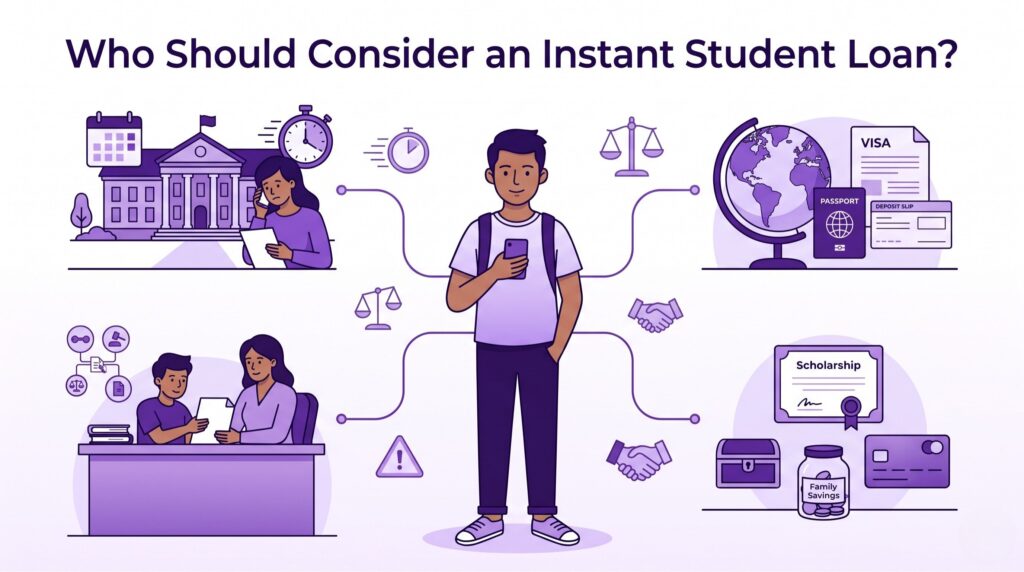
Students with the least amount of time to pay fees and a clear offer of admission are, by far, most positively impacted. If the requirement is small (generally up to a few lakhs), then instant unsecured or NBFC loans are feasible.
For public college seats where delay causes forfeiture of seat or scholarship, instant loans provide a vital bridge.
Important: Instant loans are best when you have a co-borrower with steady income or an existing bank relationship; if you need large funding for multi-year courses, compare full-term education loans, as instant products may have higher cost.
Students going abroad — pros and cons for admission deposits and visa proofs
Pros: Instant loans serve as quick funding or bank guarantee for deposit and visa documentation purposes (like proof of funds). NBFCs and fintech can quickly issue payment documents.
Cons: Standard education loans usually come with longer moratoriums, lower interest and collateral options and fund the entire course at a foreign institution. Also, cross-border disbursal and foreign exchange compliance can add time; ensure the lender handles international transfers and provides necessary documents for visa authorities.
Tip: Apply for an instant loan to lock the deposit & submit proof of visa; apply for a longer-term foreign-study loan if possible
Parents, guardians, and co-borrowers — responsibilities and risk factors
Co-borrowers (commonly parents) share legal liability. In instant lending, lenders often rely on co-borrower income for quick underwriting; a salaried parent with clean bank statements and a high credit score speeds approval.
Risks: Co-borrower credit damage if defaulting; higher APRs for unsecured instant options; limited Features on moratorium. It’s always best to know about everything related to EMIs, tenure options and foreclosure charges before getting into an EMI.
Alternatives to instant loans (scholarships, education EMI cards, family funds, credit cards)
Scholarships and Grants: FREE, but may not be received instantly.
Education EMI cards: Split-fee cards or merchant EMIs offered by colleges/education portals; good for domestic tuition but may have limited vendor acceptance.
Family funds: If available, they are the cheapest and quickest.
Credit cards: If you need to make small payments urgently but can’t repay within the grace period, this is an expensive option.
Decision rule: If time is critical and alternatives are exhausted, an instant student loan is appropriate; otherwise, weigh cost against speed.
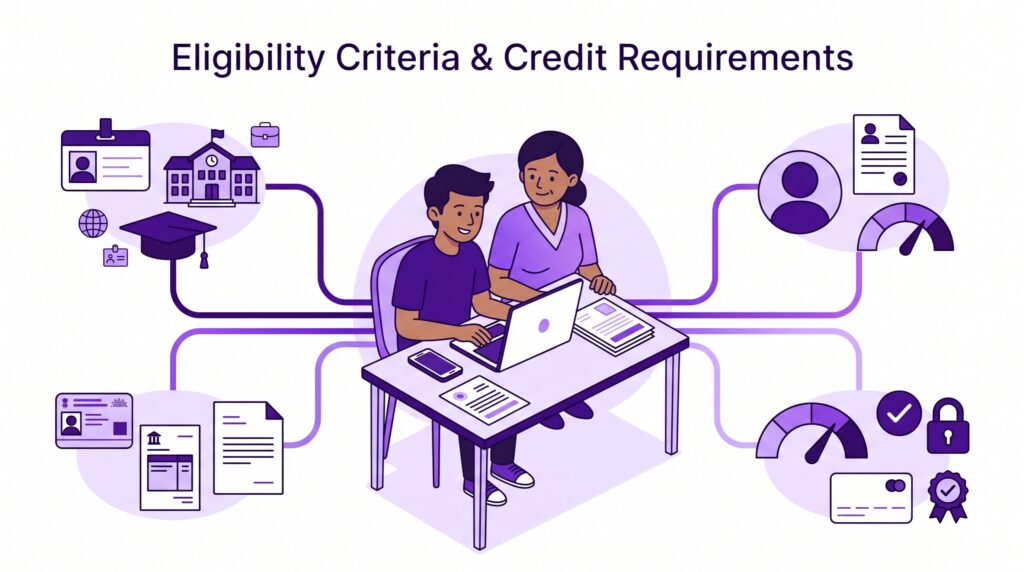
Eligibility Criteria & Credit Requirements
Typical borrower eligibility (age, residency, course type, Indian citizen/NRI differences)
Age: All lenders see borrowers/co-borrowers’ age in the acceptable range (student: Normally 18–35 for applicant; co-borrower age — up to retirement age as per lender).
Residency: Indian citizens and resident Indians have standard grounds. NRI and OCI applicant documentation varies and often requires an Indian co-borrower; some banks/NBFCs offer NRI-specific products.
Course type: Lenders prefer known institutions or reasonably accredited courses (Engineering, Medicine, Management, Law and trusted foreign universities). Short-term certificate courses may face stricter scrutiny or lower loan amounts.
Employment status: For students, full-time admission into a recognised program must be obtained. Co-borrowers with permanent salaried income or business income are the lender’s preferred ones.
Co-borrower rules — parents, spouse, guardians (preferred co-borrower profiles)
Preferred Co-borrowers: Working parents with a decent work profile, a spouse earning and with an established credit report or guardian having good credit score and income confirmation.
Why co-borrowers matter: Instant approvals are often based heavily on co-borrower salary slips, bank account history and CIBIL score. A good co-borrower lessens scrutiny and quickens the process.
Multiple Co-borrowers: Certain lenders accept both parents as co-applicants, which increases the possibility of obtaining a higher sanction amount.
Minimum documentation for instant approvals (Aadhaar, PAN, bank statements, admission offer)
Basic documents for fast-track: e-KYC (Aadhaar & PAN), recent bank statements (generally last 3–6 months), admission/offer letter or fee invoice, co-applicant salary slips (last 3 months) or IT returns (last 1–2 years).
Digital readiness: e-KYC through Aadhaar OTP, digitally signed admission letters and electronically verified PDFs for bank statements accelerate automation checks.
Credit score thresholds and impact of CIBIL/Equifax scores in India
Typical cut-offs: Co-borrower CIBIL/Equifax scores greater than 700–750 are preferred for instant approvals, without a long pre-applicant process. Scores in the mid-650s, 660s and down to low 700s might be acceptable, but perhaps with more interest or being secured.
Impact: Low scores trigger manual underwriting, slower approvals, higher interest rates or loan decline. Fintech lenders sometimes accept lower scores but charge higher APRs and smaller amounts.
Soft pulls and pre-approvals: Pre-approval may require a soft credit check if your data was pulled in the past; however, at the application stage, a full hard pull is made.
Special cases: students with no credit history, part-time working students
No credit history: Most lenders assess the co-borrower’s credit and bank statement behaviour. In order to underwrite, fintechs could look to alternative data (i.e., income flows, transactions using a digital wallet).
Students working part-time: Income from a part-time job helps, but rarely replaces the need for a solvent co-borrower. Document accordingly: employment letter, contractual agreement and regular inflows.
Mitigants: Secured loans (FD-backed OD), guarantors, or smaller unsecured personal loans to meet immediate needs.
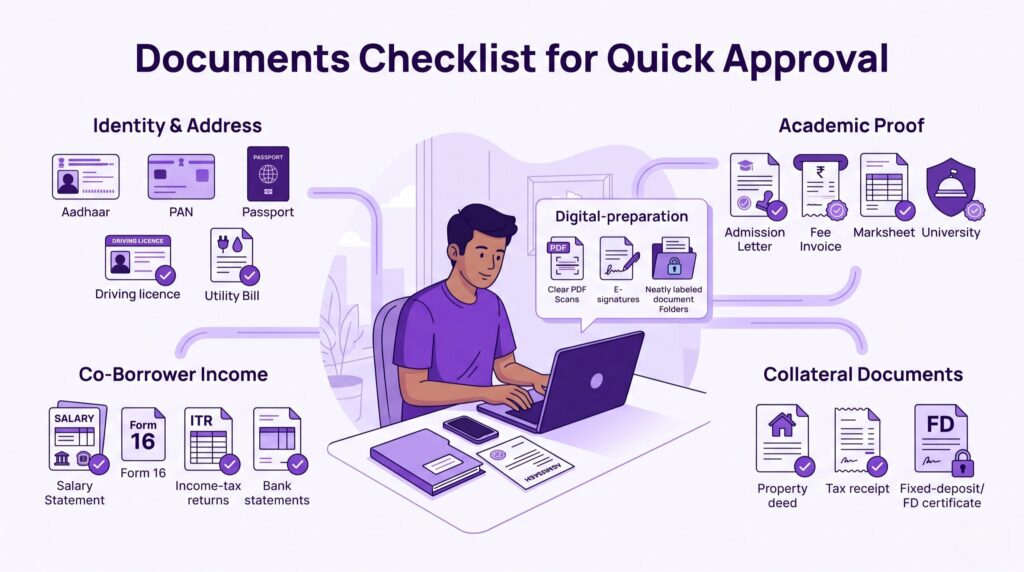
Documents Checklist for Quick Approval
Identity and address documents accepted (Aadhaar, PAN, passport, driving licence)
Primary ID: Masked Aadhaar or Aadhaar full as needed.
Tax ID: PAN is typically mandatory for loan amounts above a threshold; lenders use PAN for credit checks.
Alternative IDs: Passport and driving licence are some of the best options for students travelling abroad.
Address Proof: Aadhaar, Passport, Utility Bills, or Driving Licence. Do not hesitate to make sure that the address matches bank records, or else a delay can arise.
Academic proof and admission/offer letter specifics (domestic & foreign universities)
Offer letter for admission: Must mention student name, course, fee and deadline/payment guidelines clearly. Foreign universities: Confirmation of seat; confirmation of fee deposit amount
Fee invoice/invoice breakup: A cost breakup together with a thorough tuition fee invoice and instalment cut-off dates help lenders evaluate disbursement & screen the urgency.
Academic qualification: Last certificate/marksheet and identity on the form
For foreign study: Includes visa interview appointment, university fees payment, counselling letter (if required).
Income proof for co-borrower (salary slips, Form 16, IT returns, bank statements)
If salaried co-borrower: Salary slips for the last 3 months, Latest Form 16 or employer certificate, and last 3–6 months’ bank statements showing salary credits.
Self-employed: ITRs of the past 2–3 years (last 2 years if loss), balance sheet/p&l (if required) and business bank statement.
Bank statements: Digital statements in PDF format, complete with details about transactions and salary credits, are necessary for fast automated verification.
Collateral documents (if secured loan) and property valuation basics in India
Secured loans: Title deed for the property, copy of the latest tax receipt of the property, approved plan and identity document of the owner
Valuation: Banks may request a property valuation to be carried out by supporting valuers, which can elongate the time from application to disbursal. Lenders will be averse to unsecured large tickets and may prefer OD against fixed deposits, as a direct valuation is not required in the case of instant loans
How to prepare a clean application for instant processing (scanning, e-sign, digital KYC)
Scan high-quality PDFs, not blurry pictures; scans should be clear and readable, single-sided.
e-Sign and Aadhaar OTP: Use these to expedite identity verification using e-sign services and Aadhaar OTP-based E-KYC;
Merge Docs: Create ONE ZIP/PDF with labelled files (PAN. pdf, Aadhaar. pdf, OfferLetter. pdf, BankStmt. pdf).
Pre-fill forms: Enter correct information that matches IDs and bank documents to prevent rejections and further verification steps.
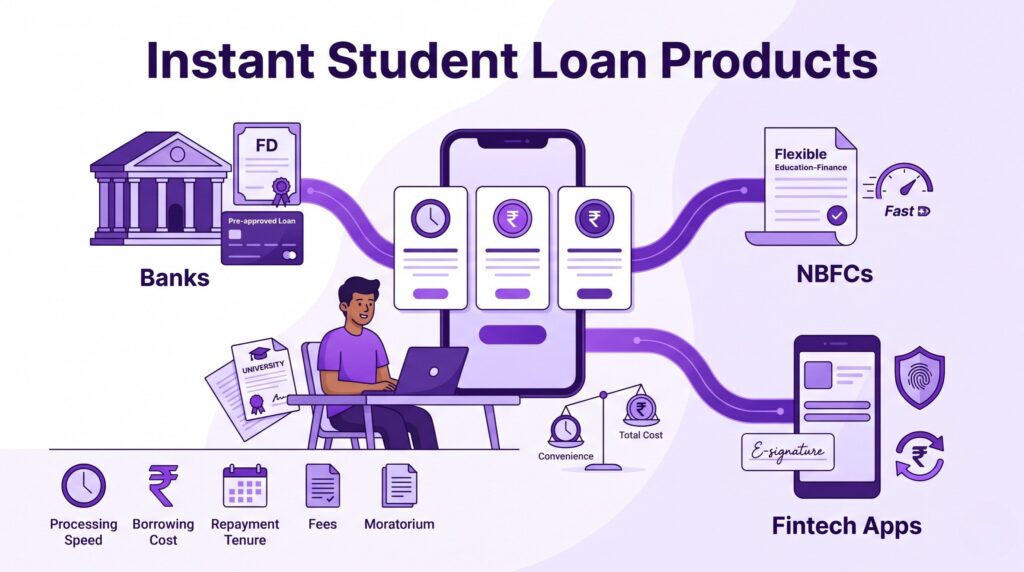
Instant Student Loan Products: Banks, NBFCs & Fintechs
Major Indian banks offering fast-track education loans — features & limits
There are many large (both public sector as well as private sector) banks which give special attention to education loans, because they know that most of their customers will take an education loan sooner or later, and when they set up their relationship in these scenarios, the existing customer often gets faster track access to a “Fast Lane” or “Pre-Approved” education loan product within respective institutions. Features typically include:
- Preset limits for verified salaried customers or Salary a/c holders.
- Instant sanction of collateral-free domestic tuition needs up to a preset limit (say, Rs. 2–10 lakhs).
- Unlike NBFCs / fintechs, competitive interest rates (usually lower) and established grievance redressal.
- Ceiling amounts: depend on the bank; high figures and collateralised loans still need a valuation and take longer.
Examples of bank fast-track mechanisms:
OD against FD: pledged – immediate availability.
Pre-approved Personal Loans: For eligible customers, issuance takes 24-48 hours.
EMI/merchant finance tie-ups for education: Banks tie up with colleges/portals to provide their own split-payment solutions;
NBFCs and specialised education lenders — speed vs cost trade-offs
NBFCs focused on education finance (specialised lenders) provide tailored products:
- Faster underwriting through the use of education-specific risk models.
- Collateral flexibility: Guarantors or low security for some programs.
- More flexible in terms of deposits for foreign-study or atypical courses.
Trade-offs:
- Interest rates and processing fees are typically higher than banks.
- Brief moratoriums in instant products, reading terms properly.
- Quick decisions with flexible policies, but total cost (APR) must be monitored.
Fintech players and app-based instant disbursals — typical product flow
Product flow for fintech instant student loans:
Pre-qualify with a soft credit check and bank account link.
Documents To be Uploaded: Aadhaar, PAN, Bank Statements, Offer Letter
Automated matching: Online mapping of bank statements, KYC through Aadhaar; instant card decision machine
e-Sign sanction letter: borrower/co-borrower e-signs.
Disbursal: NEFT/RTGS/UPI transfer or directly towards university fee payment
Benefits: Speed (minutes to 48 hours), digital convenience, and low-value instant funding.
To be careful: Higher APRs, short tenor, not so much regulation compared to banks – check compliance and reviews.
Education overdraft and pre-approved offers from banks — how they work
Education OD: Banks offer an overdraft limit against FD or connected to a salary account for qualifying student borrowers. Interest is charged based on the amount withdrawn; flexible withdrawal helps schedule varying fees.
Pre-approved offers: Banks dish out ready-to-go personal or education loans which can be accepted within minutes based on relationship banking and past credit behaviour. They usually include pre-checked documents and an easier sanction process.
Use-case: Ideal for a verified borrower needing immediate funding on predictable terms.
Comparing tenure, rate, processing fee and moratorium across provider types
Banks: Lower interest rates, longer tenures (up to course duration + moratorium), structured moratoriums, lower processing fees; even slower on large secured loans.
NBFCs: Moderate interest, lower to medium-term loans, quicker decisions but higher processing fees, more freedom for collateral.
Fintechs: Highest unsecured fast loans, shortest tenure period, high charges, high processing fees, disbursement in minutes.
Moratorium: Banks frequently provide course-completion moratorium followed by a specified repayment holiday; fintech/instant products may have limited moratoriums—read sanction letter carefully.
Takeaways: Fintechs/NBFCs provide ease of access for small, urgent payments; opt for bank education loans for all-encompassing funding with deferred loan payback needs.
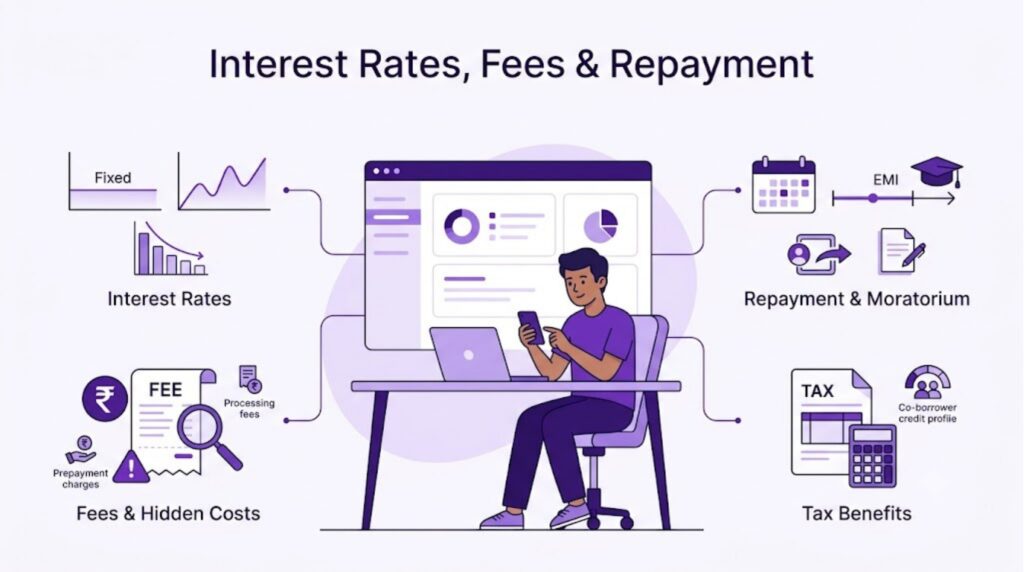
Interest Rates, Fees, Repayment & Moratorium Explained
How interest is calculated for education loans in India (fixed vs floating)
Fixed Rate Loans: Interest rate remains fixed during the loan tenor; predictable EMIs.
Floating rate loans: These are linked to a benchmark (MCLR, external benchmark rates), and borrowers will either have their EMI change or tenure change based on the lender’s EMI reset policy.
Interest calculation methods: Monthly reducing balance method is common—interest charged on outstanding principal reduces as EMIs amortise principal.
For Overdrafts: Interest is charged on the amount you withdraw (daily/ monthly) instead of the total sanctioned limit.
Typical interest rate ranges for instant loans and cost drivers
Instant fintech/NBFC unsecured personal loans: 12%–28% APR based on credit profile
NBFC educational loans: 10%–18% approximately, based on the product and security.
Bank higher education loans: Generally 8%–15% for subsidised products; standard bank education loans vary widely.
Cost drivers:
- Credit profile and co-borrower.
- Loan amount and tenor.
- Secured vs unsecured structure.
- Type of product (money is generally more expensive in the case of instant disbursal) and urgency.
- Relationship benefits (salary accounts, existing loans may offer lower rates)
Processing fees, prepayment charges and hidden costs to watch
Processing fees: One-time fees often 0.5%–3% of loan amount; fintechs may charge flat fees.
Prepayment/foreclosure charges:
Banks: Many education loans from banks allow you to do prepayment at low or no cost for floating-rate loans, but this varies, so read the terms.
NBFCs/fintech: May apply foreclosure charges for fixed-rate or personal loan versions
Other costs: Fees like GST, legal and valuation for secured loans, charge for disbursal (for international disbursals), loan document stamp duty.
Things to watch out: Conversion charges (moving from floating to fixed), re-submission of documentation fees, and penal interest on late payments.
Moratorium and repayment start — domestic vs foreign study loans
Domestic education loans: Typically include moratorium during course duration and a grace period after course completion (6–12 months) before EMI starts; specifics depend on lender.
Foreign study loans: Up to the end of the course + 6 months set by some lenders; others require earlier repayment commencement. For instant products, moratorium may be limited / not available—check with lender.
Usually, a moratorium is rarely, if ever, available for quick short-term bridging loans; the start of EMIs could also be immediate or within one month.
Tax benefits under Section 80E — what qualifies and Indian filing tips
Interest on a loan taken for higher education is allowed under Section 80E of the Income Tax Act to the parent/student repaying.
Qualification: Education loans taken for self or a family member spouse or children in India or abroad, along with the condition that this education loan must be obtained from either a bank / financial institution / RBI-approved lender.
Filing tips:
- Maintain interest statements and lender certificates for ITR filing.
- The deduction is only for interest, not the principal
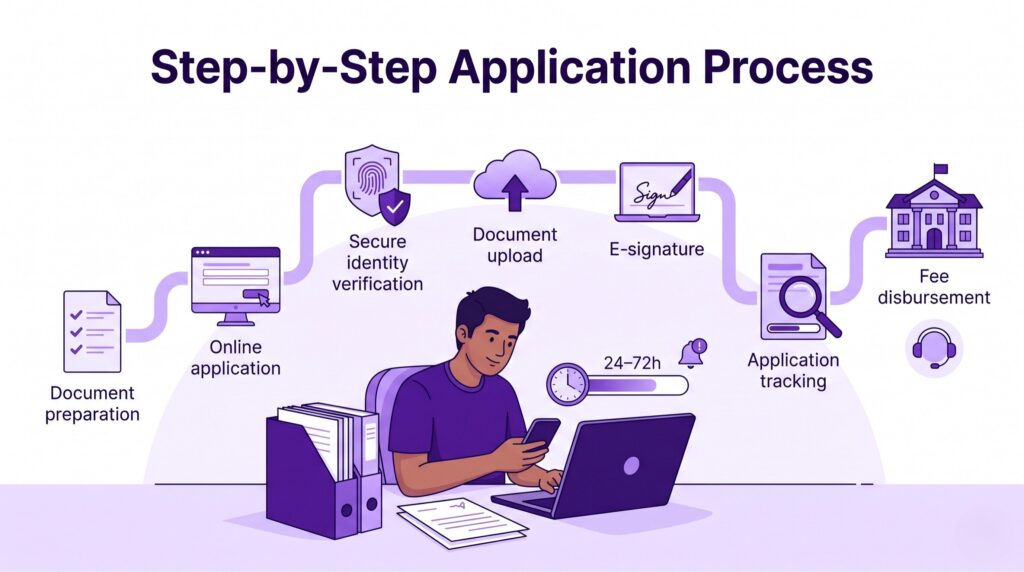
Step-by-Step Application Process for Fast Approval
Pre-application checklist and documents readiness
- Student and co-borrower Aadhaar & PAN in line.
- Admission letter/ offer letter and fee invoice
- 3–6 months bank statements (for student and co-borrower).
- Recent 3 months salary slips or last 2 years ITRs (in the case of a self-employed co-borrower).
- Scanned copy of ID/proofs with address and passport if you are located overseas.
- The digital signature for e-KYC and e-sign through mandate/consent.
Tip: Prepare PDFs digitally with clear file names, which will save students from upload errors.
Online application flow — upload, e-KYC, e-sign and tracker tips
The bank will have its own dashboard where a lender can select the lender as well as the product, and there is also an instant /preapproved option.
Enter your basic application info with correct details matching ID and Bank records.
Attach all the PDFs you may have: offer letter + bank statements + PAN + AADHAAR + salary slips/ITR.
E-KYC and e-sign sanction letter (if applicable) are to be executed using Aadhaar OTP
Monitor application through lender online portal/mobile app.
Rapid verification shortcuts lenders use (instant bank statement parsing, Aadhaar OTP)
Bank statement parsing: How many salary credits, what are the patterns of tuition payments and monthly inflows to measure repayment capacity automatically
Aadhaar OTP e-KYC: Skips physical KYC using instant identity checks.
Auto-populated sanction fields: Most of the fields are auto-filled for approved clients, thereby minimising manual checks.
Do not delay your case by declaring income backed by inconsistent bank statements.
What to expect in the 24–72 hour approval window and follow-up actions
Hour 0–6: Review of application and automated checks.
Hour 6–24: Verification of the documents submitted and credit check; the lender may call to clarify queries.
24–72 hours: Sanction letter along with disbursal initiation and e-sign (once returned and conditions satisfied).
Follow-up actions:
Pick up calls/emails/hang-out messages from the lender verification team on time.
Upload any missing docs immediately.
Request that the funds be transferred directly to the university whenever possible to close as quickly as possible.
How to escalate or expedite if deadline is near (Bank Nodal officer, grievance channels)
Steps to expedite:
Get in touch with the relationship manager or dedicated desk for education loans using the application ID.
Get a pre-sanction/conditional letter from the university to prove the funding during the initial interview.
Call out to the bank: You can contact these grievance/nodal officers when a transaction gets stuck.
If urgent, request an interim instrument (OD against FD, overdraft or pre-approved personal loan) till the full documentation process is done.
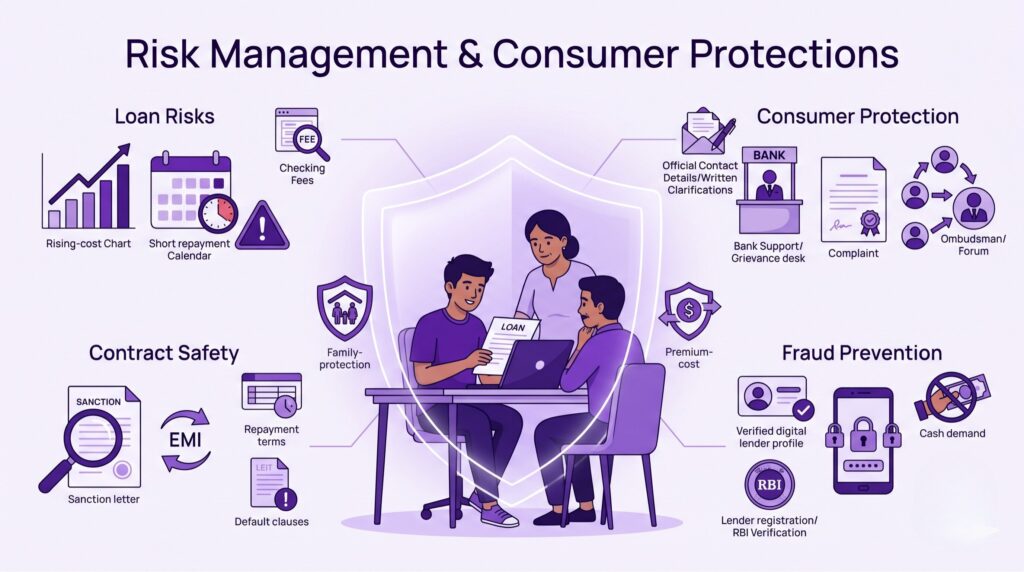
Risk Management & Consumer Protections
Common pitfalls of instant loans (high APR, short tenures, aggressive recovery)
High Interest Rate: Instant unsecured loans tend to be a lot more expensive than regular education loans.
Duration: Higher EMIs are likely, especially for shorter loans
Aggressive recovery: NBFCs/fintechs may have stricter recovery mechanisms; ensure you know default clauses and grace periods.
Read the sanction letter — clauses to check (EMI reset, default definitions)
Key clauses to examine:
- Fixed/floating interest rate and conditions under which EMI changes.
- Prepayment/Foreclosure charges and mandatory notice period
- Default and default interest
- Disbursal Terms (to uni account or provided to borrower’s a/c).
- Details on the moratorium and starting date for repayment after the end of the course.
- Don’t sign blindly: make sure to ask for and get explanations on clauses that seem unclear; prefer written clarifications.
Banking ombudsman, RBI guidelines and grievance procedure in India
Consumer protections:
Banks and regulated NBFCs are guided under RBI; you can escalate pending concerns to the Banking Ombudsman or RBI consumer grievance portals.
Preserve all communications, application IDs, and letters of sanctions; this would be required when certain complaints are filed.
Steps: Approach the grievance cell of the lender(if the borrower is not satisfied, then escalation to the nodal officer, and if still unresolved within prescribed time limits, then escalate it to the Banking Ombudsman )
Insurance/loan protection options and their pros/cons for students
Insurance: Loan protection insurance or accidental death/disablement which pays off your debt in the event of critical scenarios.
Pros: The co-borrowers can be relaxed; prevents unexpected events.
Cons: Cost contributes to total loan costs; some policies have exclusions; assess each policy’s premium vs. benefit carefully.
Tips to avoid fraud and fake lenders (verification checklist)
Learn about your lender: For instance, are they an RBI-registered NBFC like us, or do they have a bank licence or even details about the registration of a credible fintech?
Contact verification: Official site, customer support numbers and a real address.
Do not ask for cash in advance: If it’s a legit lender, it’ll deduct the fees from disbursal or use digital payments.
Verify reviews: Consult independent reviews and request a sample sanction letter.
Avoid sharing the complete OTPs of Aadhaar SMS or any netbanking credentials.
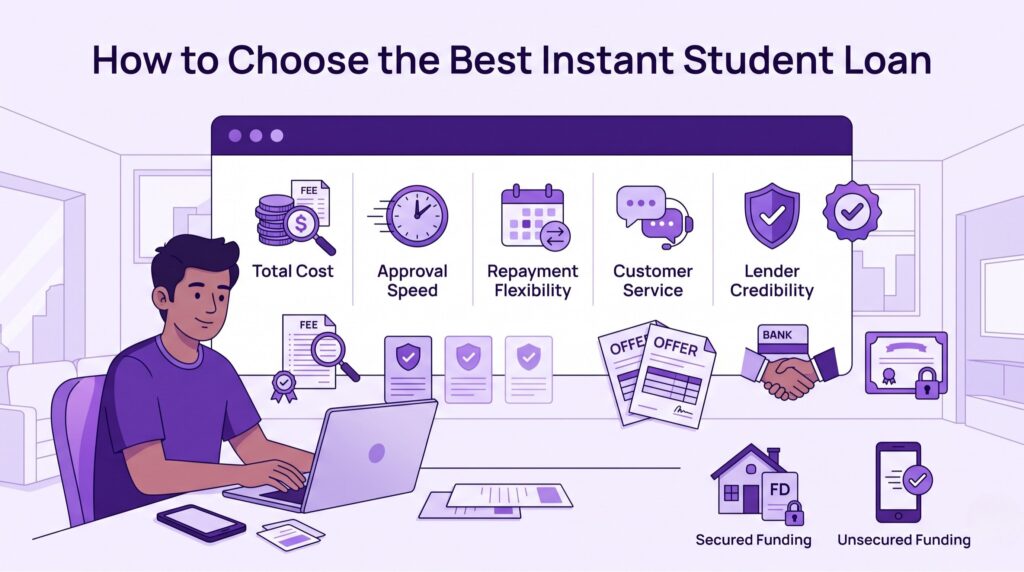
How to Choose the Best Instant Student Loan — Comparison Framework
Decision matrix: cost, speed, flexibility, customer service, credibility
Cost: You shall be offered an interest-effective Annual Percentage Rate (APR), which will include processing, prepayment and also Foreign exchange transfer fees for any international payments
Speed: In terms of time to sanction and release, as the requirement might be critical
Customisation: Moratorium, repayment profile [tenor of the loan], restructuring help, partial payment acceptance
Customer Service: Ease of contact, grievance/issuse resolution and clarity in communication.
Credibility: Availability of bank/NBFC/fintech credentials, RBI/NBFC registration and history of user feedback and complaints.
Scorecard template for shortlist (interest, fees, tenure, moratorium, lender rating)
Create an easy scoring grid (1–10) for each funder
- Interest rates (lower is better)
- Effective cost (interest + fees)
- TAT (Sanction + Disbursal)
- Moratorium flexibility (longer/better)
- Customer Experience (Reviews, Complaint Resolution)
- Overall score —> shortlist 2-3 lenders.
Negotiation tips with banks and where leverage exists (salary account, relationship banking)
Relationship: An existing salary account, fixed deposits, or multiple products with a bank help you get lower rates and quick processing.
Request charges: Borrowers can negotiate for processing charge waivers or lower fee expenses for pre-approved customers.
Collateral/Guarantee if required: Pledge of FD/property can help lower the rate and speed up approval.
Use competing offers: Show written pre-approval offers from other banks.
When to prefer secured vs unsecured instant funding
Go for secured if the loan is high & you want a lower rate (FD-backed OD or mortgage of property).
For immediate needs for small ticket sizes, prefer unsecured as documentation and valuation related to collateral will take a lot of time before disbursal.
Mix Method: Take an instant unsecured (fill gap), then refinance into a secured/bank grant mortgage to meet time limits.
FAQs
Can I get an instant loan without a co-borrower?
Yes, many fintechs and some NBFCs do give unsecured instant education or personal loans of small-ticket sums (without a co-borrower), but interest rates will be higher and the maximum amount is limited. Banks also normally ask for a co-borrower if you are obtaining loans to cover larger education expenses.
Will an instant loan affect a visa application for foreign study?
Properly documented instant loans and official sanction/disbursal letters are acceptable as proof of funds in many cases. Verify the lender with a sanction letter or bank statement, confirming funds or that they are directly paying the university. Verify the proof by checking with your embassy/visa guidelines.
How fast can funds be disbursed to a foreign university?
For instant-capable lenders, tuition deposits could be wired within 24–72 hours, assuming that forex compliance checks and beneficiary details comply with formalities. The processing time for international money transfers and the fees charged to the recipient vary by banks and beneficiary country; keep the lender informed about delivery mode and transfer costs.
Can I pre-close an instant education loan and any charges?
The option for prepayment is free of charge for almost all floating-rate education loans by banks, while it could be levied by NBFCs/fintechs, particularly when the product is fixed-rate. Read the sanction letter and be sure to inquire about the prepayment penalty.
What if the admission gets cancelled after disbursal?
If cancelled after admission, report to lender immediately. According to your lender, this may be deemed repayment of the loan, or your lender will accept the returned funds depending on the lender’s policy and documentation (refund from university). Retain the documented evidence of refund correspondence; failing to receive a response from the lender grievance cell.
Conclusion & Next Steps
Instant student loans are practical when time-critical payment is required (tuition fee deadlines, accommodation timings, foreign admission payments) and the alternatives (family funds, scholarships) have been exhausted. They’re great for urgent funding in small-to-medium amounts, short-term cash-flow gaps, or visa proof of funds. As a result, instant products usually cost more and offer shorter terms or moratoriums—when feasible, plan to refinance into long-term education loans with lower interest rates.