
Download StuCred.
The Real Time Student Credit App.

Student Loan for Laptop in India — Complete Guide to Funding, Schemes, Eligibility & Best Options
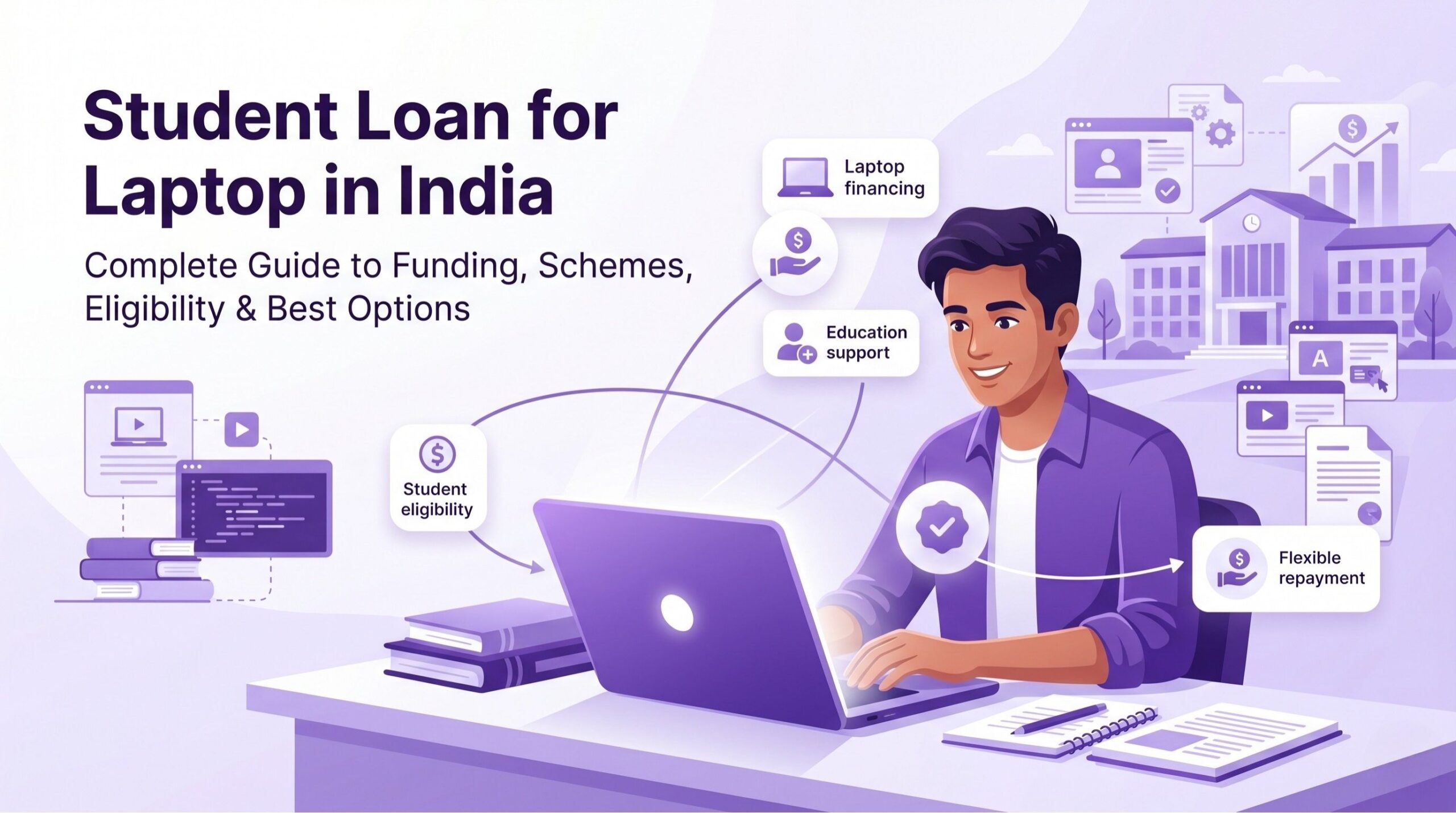
After admission, the first financial decision students need to make is usually buying a laptop. A good laptop is essential for completing your assignments, coding, designing, and attending online classes and internships. However, not all families can make a one-time payment of ₹40,000–₹1,20,000, so they seek financing: an education loan for a laptop, a personal loan, vendor EMI, an NBFC laptop loan, or scholarship top-ups. This guide clarifies the broad concept of buying a loan for a laptop, step by step. Practical guidance on application period and easy alternatives, as top-level lenders are financed directly through government schemes or institutional distributors, warranty/insurance protection of purchased laptops with real student case studies, FAQ and a close functional action plan for you to borrow loans for your new laptop. Leverage this to evaluate interest rates, total payable amounts and eligibility, and choose the safest route to purchase a laptop through EMI in India.
What do Indian students mean by “loan for laptop”
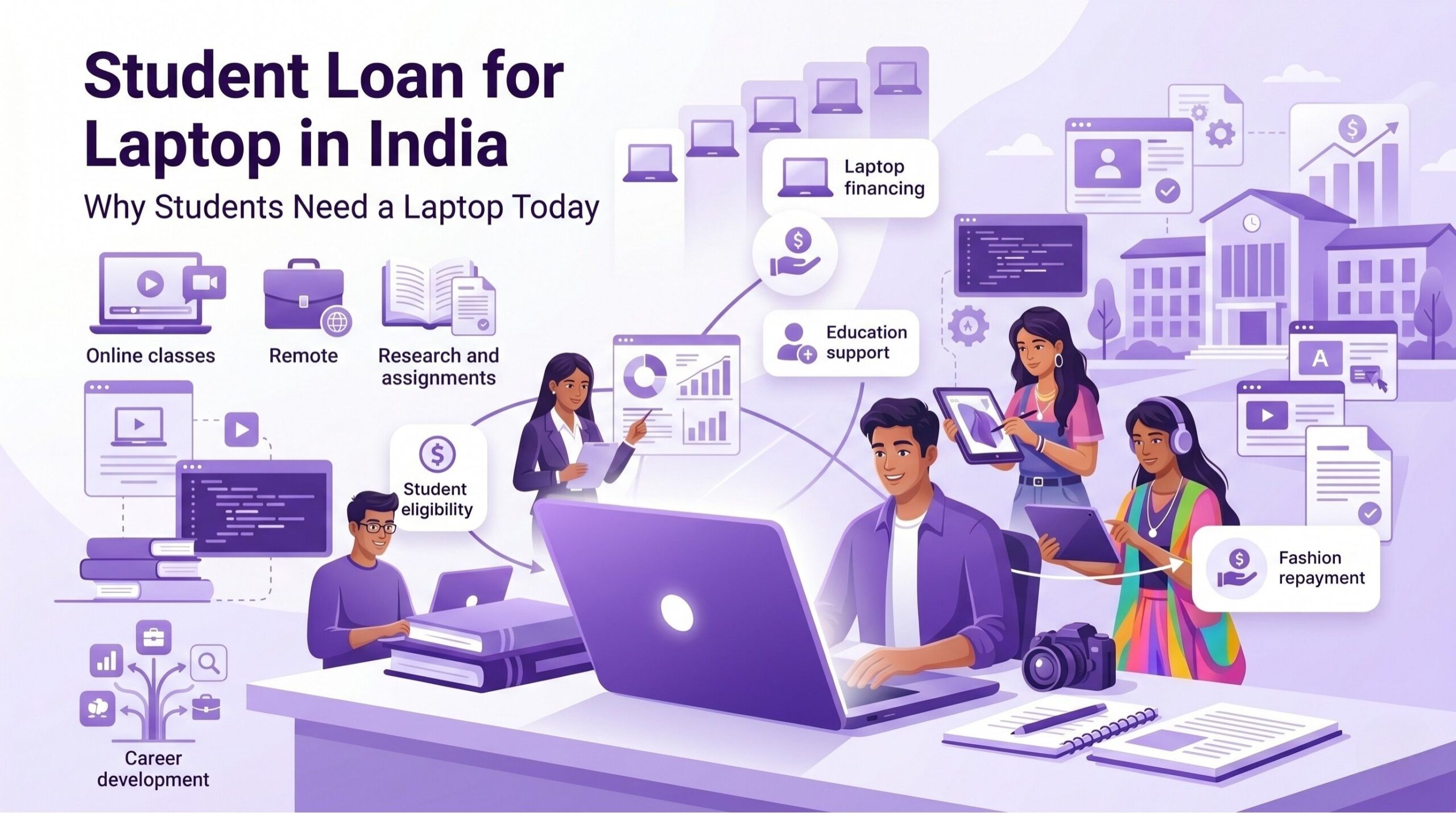
Why students need a laptop — degree and career contexts
In fact, a laptop is hardly an optional item for several courses — programming labs, CAD, video editing, data science, and even online exams and research/internships — and many get by without a personal machine. Laptops are a prerequisite for completing assignments, writing code, and simulation work in B.Techs and other design or mass media/commerce based courses. Remote internships, freelancing, and even skill-building (online courses, certifications) can also be done through laptops. To students who work, a laptop is not just an added convenience; it is an income-enabler.
Typical laptop cost ranges by course (B.Tech, MBA, Design, Fashion, Media)
B.Tech/CSE: ₹50,000–₹1,20,000 for a capable configuration (i5/i7, 8–16GB RAM, SSD, GPU for specialized branches).
MBA: ₹40,000–₹90,000; portability for travel and battery life (MS Office/analytics tools)
Design (UI/UX, Animation): ₹ 60,000–1,50,000 based on GPU and display colour accuracy.
Fashion/Textile: ₹45,000–₹85,000 worth of design software and portfolio work
Prices vary by brand, student discounts, and seasonal sales; refurbished models can significantly reduce the price.
Short-term vs long-term needs — laptop as essential vs discretionary
Consider laptops must-haves — especially when coursework or internships require dedicated software or remote proctoring. If you are more looking for devices or tablets to browse the web, take notes, etc., we are updating you on cheaper options here! Identify: functional (loan + education loan equipment ) vs discretionary upgrades (a better CPU/GPU for hobby projects — consider EMI or savings)
Search intent of learning whether to buy, finance scholarship and loan difference.
The four major intents while searching by students are:
(1) buy now (best price, student discounts),
(2) finance (EMI, loan for laptop EMI, NBFC),
(3) scholarship/subsidy(college grants, laptop scholarship ) and
(4) alternatives (refurbished, rented).
Learn the distinction: education loan for laptop (a part of a sanctioned education loan that enables equipment), pupil personal loan for laptop (unsecured, small price tag) and dealer EMI(cardless EMIs or credit card EMI, quick but costly). This is how matching intent to urgency and ability to pay helps choose a road.
Read more
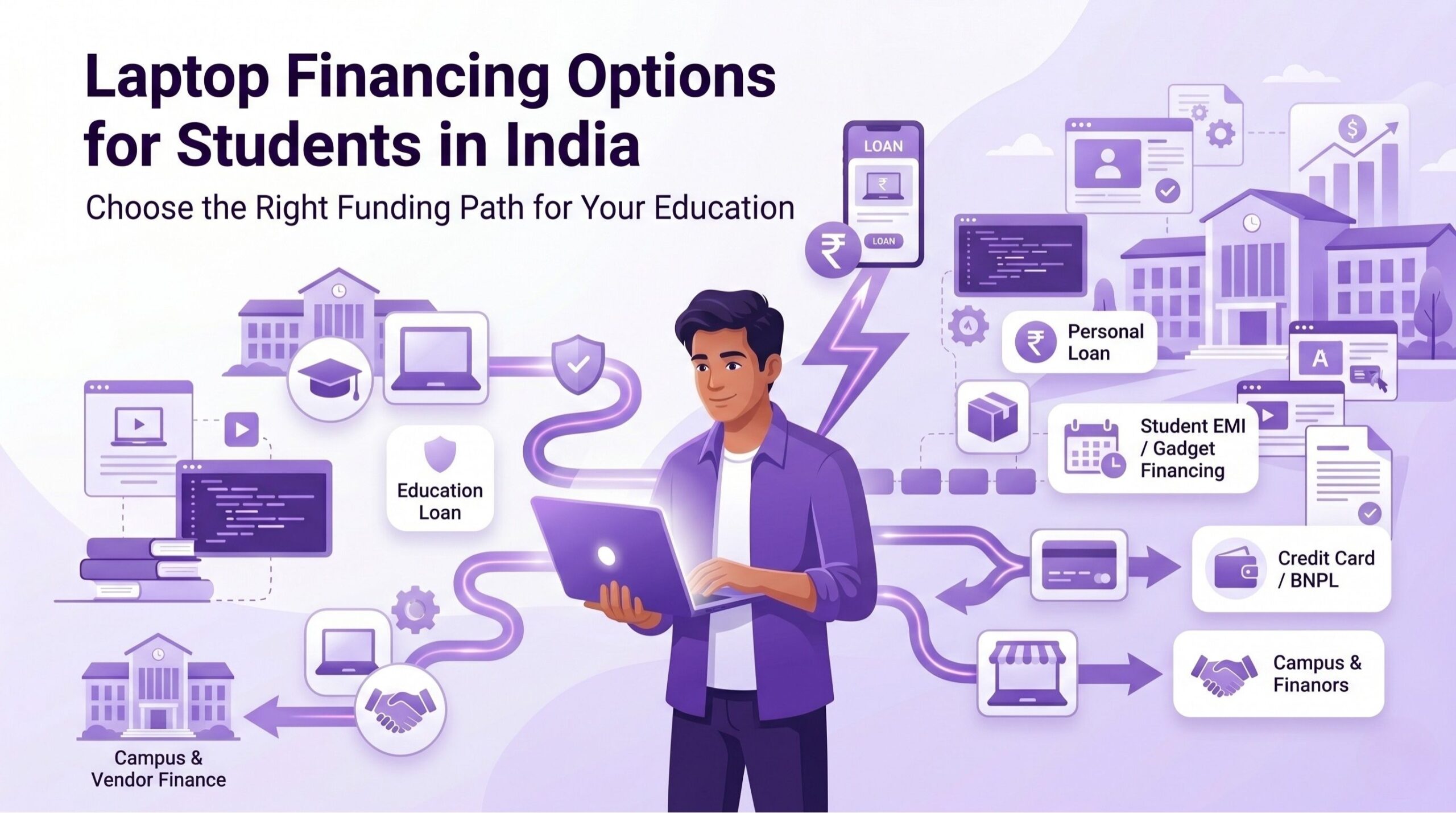
Types of financing available in India for laptops
Differences between personal loans and education loans
Education loan: Typically provided by banks and general education loan products, these generally fund only tuition; however, most clearly permit funds for equipment, books, and laptop purchases, subject to sanctioned limits.
Pros: Interest rates are lower than personal loans (especially for PSBs), Longer tenures, and a moratorium period during the course.
Cons: Documentation required can be exhaustive, and disbursal might take longer.
Personal Loans: Unsecured, faster disbursal, more flexibility in use (you can buy a laptop).
Pros: Fast online application process, few requirements.
Cons: Higher interest rates to pay, shorter tenures, and increases monthly burden.
Education loans specifically that apply towards devices and gadgets
However, a few education loan schemes mention “equipment, laptop computers” as admissible expenses. Check for equipment in product terms or ask the branch – like many SBI Student Loan, PNB Udaan and other Bank products include this under sanctioned costs. NBFC loans — and certain kinds of private bank student loans — include gadgets within the sanctioned amount; make sure the equipment/computer wording is in the sanction letter.
Student-specific unsecured loans and co-branded EMI offers
Some fintech lenders and banks offer unsecured loans only to students (in small ticket sizes of ₹10,000–₹2,00,000) with a simple onboarding process, considering potential customers who could even be college students through campus tie-ups. Interest-free or low-interest EMI (for limited tenures) — possible in co-branded offers (with a laptop brand or a retailer), but do read the processing fee and late-payment penalty.
Pros and cons of credit cards, buy-now-pay-later (BNPL) and EMI cards.
Credit cards: Use bank offers or card-based EMI to convert purchases into EMIs.
Pros: fast, structured EMIs.
Cons: high rates if not converted properly, higher late fees, potential to damage CIBIL if defaulted.
BNPL/EMI apps (Slice, Simpl, LazyPay, Amazon Pay Later): offer short-term plans (usually for a few months), often interest-free.
Pros: Almost instant access and easy KYC.
Cons: Short-term, hidden fees, and aggressive collections for defaults reported.
Pre-paid EMI card for Store Issue (HDFC, ICICI POS): Store-issued cards that provide eMIs at the time of purchase.
Pros: Less paperwork, tenures flexible.
Campus tie-ups with banks and vendor finance
All Retailers (Croma, Reliance Digital, brand stores) and all e-commerce marketplaces have vendor finance for in-house BNPL or tie-ups with banks/fintech for EMI plans. Colleges also negotiate bulk discounts and EMI tie-ups with banks or NBFCs, which allow students to apply on campus with less eligibility (and sometimes no co-applicant). You have contracted vendors, and campus tie-ups can be one of the easiest ways to buy a laptop on EMI in India, but confirm interest rates, processing fees & warranty support.
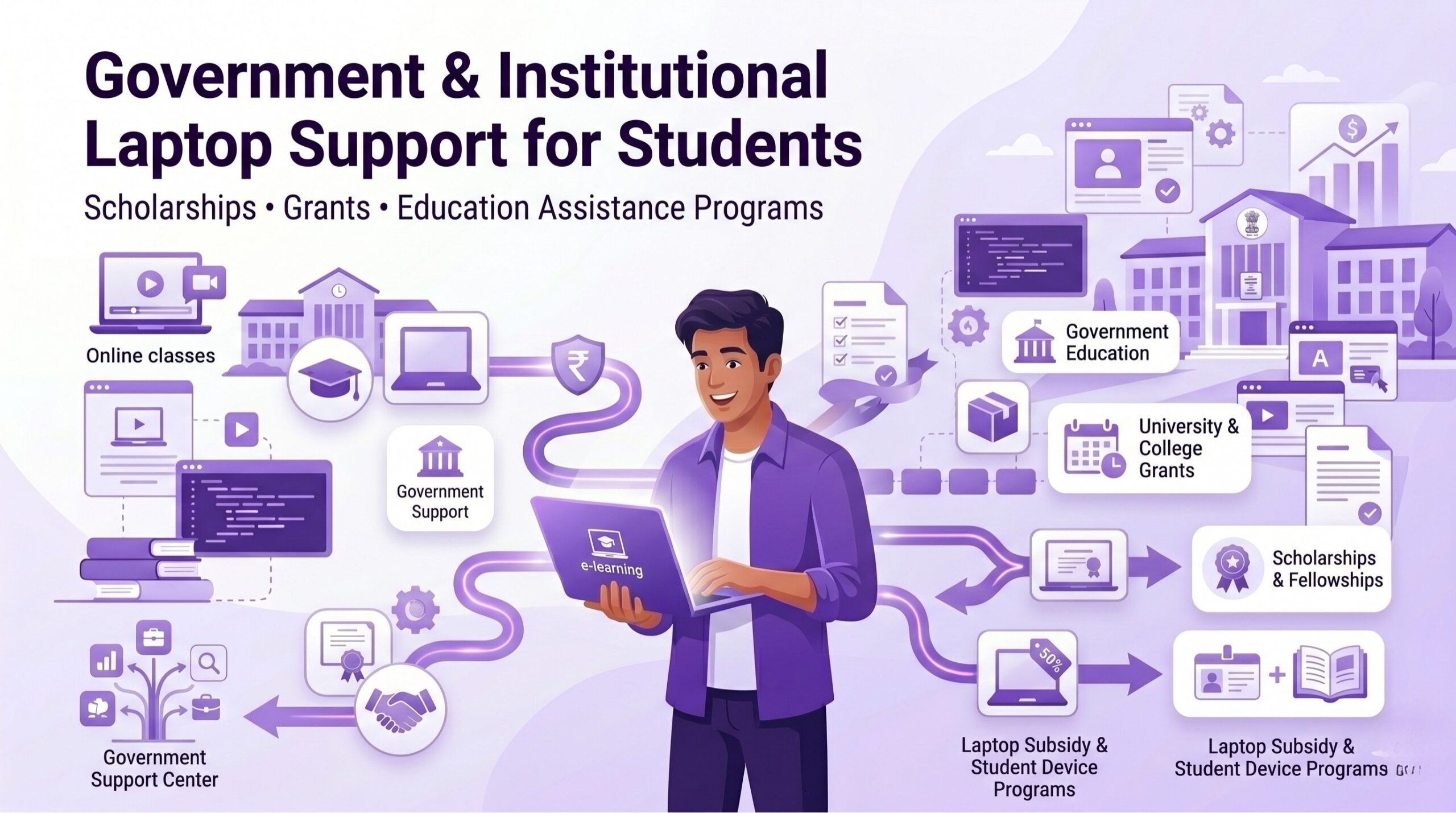
Government and institutional schemes that can be used for laptops
Central/state education loan schemes that allow funding for equipment purchases
Various central and state government-backed schemes provide funding for equipment; particularly, national education loan programs (NELP) or central/state student support schemes can include provisions for books, instruments, and devices. Post-matric loan schemes of many state governments and some other central schemes, such as Central Sector Scholarship tie-ups, are examples that allow the purchase of educational equipment using sanctioned funds. Always verify the scheme-specific guidance and whether laptops are explicitly listed as admissible items.
Student financial aid of university/college, grants and laptop subsidy schemes
University schemes: A few university-specific laptop subsidy initiatives or grants for deserving students (merit + need-based) are also available. Technical institutes/colleges may issue hardware grants for co-ed students of certain departments.
State governments and technical universities occasionally provide laptops or subsidize tablets for students in remote & economically weaker sections. These are also state- and academic year-dependent, and often focused on specific courses or types of scholarship recipients.
Scholarships and fellowships from which you can purchase equipment
Merit- and need-based scholarships (both government and private foundations) usually allow stipends to be used for essential tools, including laptops. You can usually buy computers with research fellowships and project grants for postgraduate students. Before making a purchase, students should read scholarship terms or fact sheets or contact the awarding body for confirmation.
Documents and deadlines to check eligibility for the scheme and apply
Verification process: Official scheme webpage and download guidelines and eligibility criteria to confirm the admissible expense list.
Frequently Used Documents: student ID, admission letter, income certification, caste/SC-ST/OBC certificate (if applicable), Aadhaar, bank account details and fee invoices. A pro forma invoice from suppliers is a prerequisite for equipment grants.
Deadlines: When applying for government and institutional schemes, keep in mind that these schemes follow academic-year calendars; deadlines must be met early (before semester fee deadlines). Maintain evidence of scholarship disbursement and permitted use during loan negotiations. You should always apply through official portals or college financial aid cells to avoid fraud.
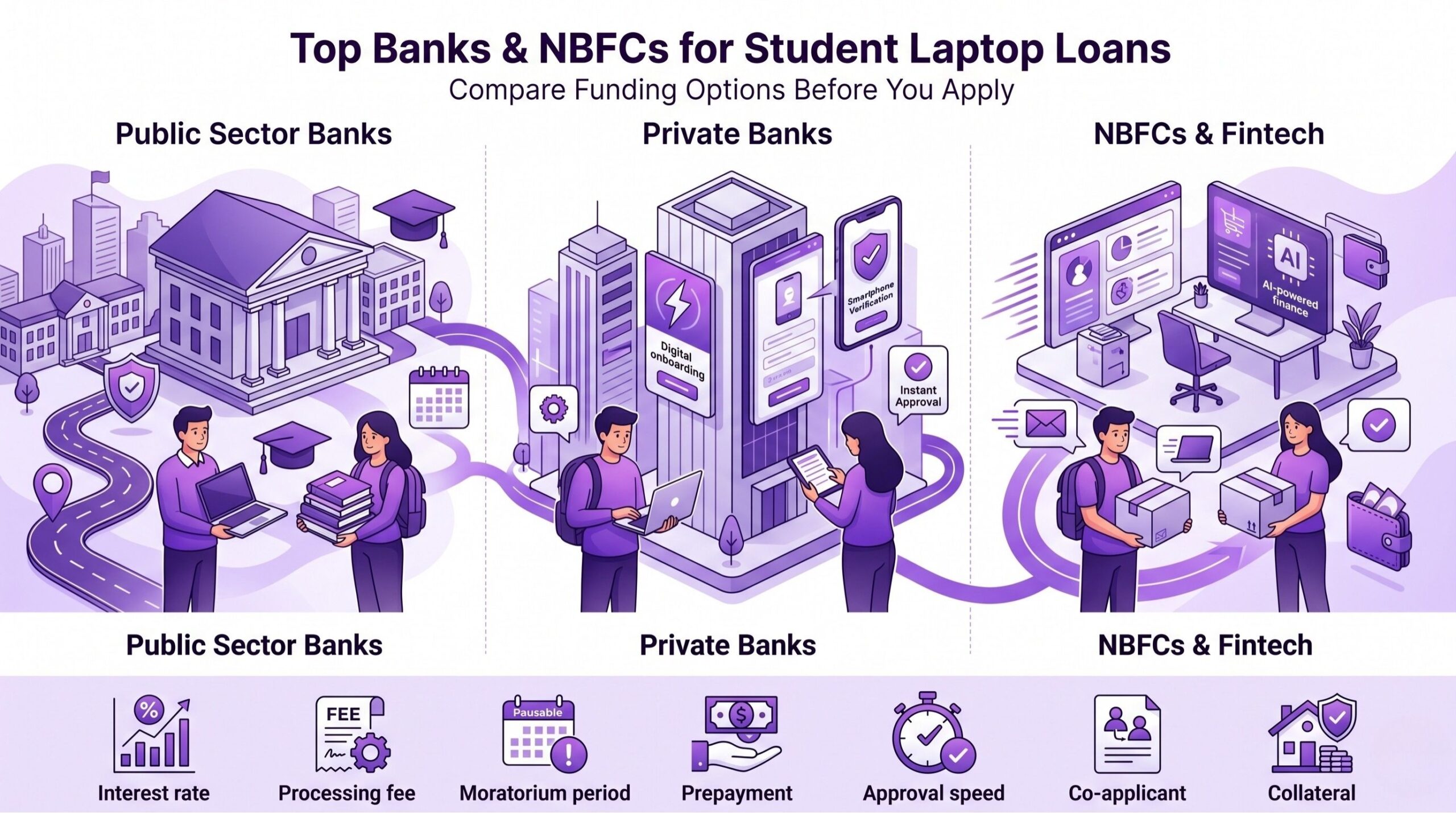
Top banks and NBFCs in India offering student loans that include gadgets
Public sector banks (SBI, PNB) — education loan features for equipment
SBI: In the funding available for student loans (SBI Scholar Loan and SBI Education Loan products), the money for books and equipment & devices is usually included in the total sanctioned amount.
Advantages: Lower interest rate, Long tenure (15 years maximum), Free moratorium during study period, Availability of branches across the country. Processing fees and collateral are based upon the size of the loan.
On this note, we have a few student loan products:
PNB: their PNB Udaan and PNB student loan products usually allow equipment purchases as admissible expenses. Low Rates, Flexible Repayment (Co-Applicant Option) – Public sector banks, in general, are more flexible on both education loans tax and moratorium clauses.
Private banks (HDFC, ICICI, Axis) — personal/student loan options
HDFC Bank: Education loans for programs & personal loans for students and young professionals. While HDFC’s personal loans offer faster disbursal through digital onboarding and fewer formalities, they also carry a higher interest rate than public-sector education loans.
ICICI Bank: This bank offers education loans and student personal loans through a digital process. ICICI also offers education loan products that can include equipment; an online personal loan facility; and a simple on-the-net percentage line.
Axis Bank: Personal and education loans available from Axis include student loans, which may incorporate allowances for equipment. Since all processing and customer service are on par with private banks (and some even charge you for special student packages), but only they can link salary or salary account post-placement.
NBFCs and fintech lenders — faster transfer and adjustable EMIs
Almost all small-ticket loans, easy KYC—fast decisioning & flexible repayment tenures offered by NBFCs and Fintech platforms(Bajaj Finserv, Muthoot Finance, Tata Capital, InCred (Formerly “Ascent”), KreditBee.
Pros: low paperwork, vendor EMI tie-ups, and ready offers for existing customers.
Disadvantages: higher effective interest rates than banks; watch your processing fee and the risk of a missed-payment penalty.
Fintech products for student loans: Some campuses are also offering these, partnering with platforms that co-create special loans and allow students to defer EMI payments until they get placed. They have a focus on speed (disbursal in 24–72 Hours once approved)
Co-signed loans, parental guarantee and collateral conditions
Unsecured loans: Available for small amounts (usual laptops) without any collateral. Guarantors are assessed by lenders based on their CIBIL score, income, and employment prospects.
Co-signer/Parental guarantee: Most lenders require a parent or guardian to act as a co-applicant with income or credit history to lower risk and secure better rates.
Collateral: Banks often require collateral (fixed deposits, property) for larger education loans (tuition-heavy programs) above a certain threshold (usually > ₹4–7 lakh, depending on bank policy). Well, you hardly need collateral for these loan components separately for small-ticket equipment.
Checklist comparison: interest rate, processing fee, moratorium, prepayment
Sector-backed education loans are lower (viz subsidized or base rate + spread), while personal loans and NBFC finance are higher, with a few exceptions- Financing has an interest rate of 0%. Always compare against the APR or effective interest rate!
Processing fees: Banks/NBFCs would charge a one-time fee (flat fee or %). Fees may be bundled into EMI by fintech vendors.
Moratorium: Education loans may provide for a moratorium until course completion plus an additional grace period, while personal loans do not.
Prepayment & foreclosure: Understand the charges for partial prepayment or full foreclosure. Some banks do not charge a prepayment penalty; others do.
Convenience & speed: NBFCs and fintechs are high; public banks provide the best price, but with longer-term terms
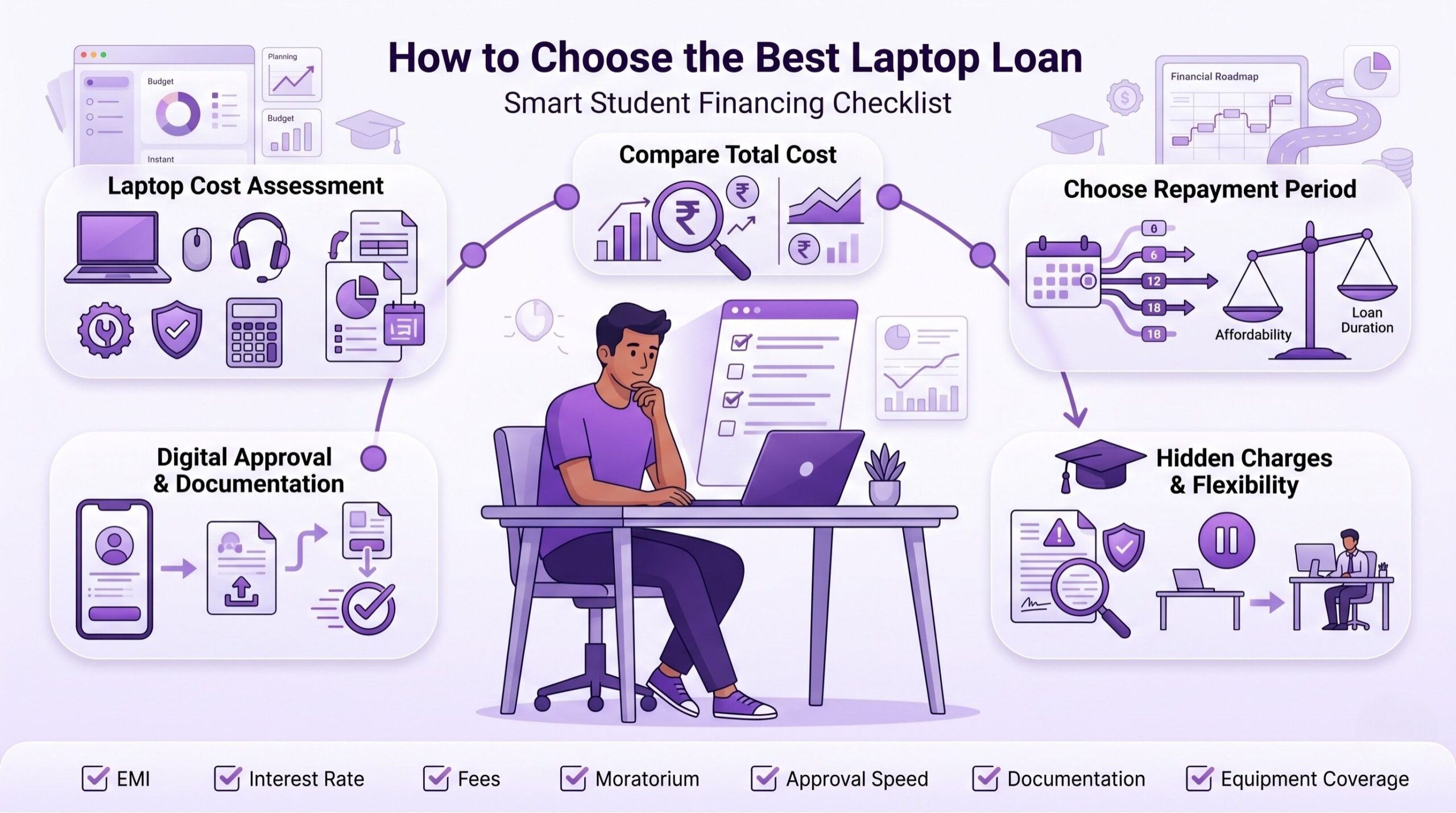
How to choose the best loan for a laptop — decision checklist
Effective Interest Rate vs Total Cost
Always calculate the loan cost in effective interest rate (EIR) or APR terms, not just the headline rate. The EMI calculator helps us measure the total interest paid over time. Calculate the total repayment for the same tenure and principal amount and compare offers.
Repayment tenure vs monthly burden: ideal tenures for students
Shorter tenures (6- 12 months) mean total interest will be lower for small-ticket loans (₹20k–₹1.2L), but make sure the monthly EMI does not strain the student’s budget! Ideal tenures:
High but affordable– 24–48 months (pass through paying with keep down pain)
Short-term required urgently: 6–12 months for interest-free vendor EMIs if available
Avoid unnecessarily long tenures for small amounts; longer tenures increase total interest.
Moratorium & deferment for continuing students
If you are still studying or anticipate a stipend/placement later, opt for education loans with moratorium (repayment deferral) until course completion. Check if interest is charged during moratorium and if it is capitalized – it will add to the loan amount.
Hidden fees, prepayment charges and penal interest to watch
Watch for:
- Processing and ceiling fees (High Flat Fee Charged by Some Lenders)
- Penalty on floating-rate loans, taking into account the fact that banks may allow prepayment for floating-rate loans after a lock-in.
- Penalty interest on EMI defaults (may be substantial).
- Top-up renewal or foreclosure charges.
- Request a detailed fee in writing and add it to your decision checklist.
Documentation ease and digital onboarding
For quick loans, go for lenders with complete digital onboarding, and they should limit physical documentation. Lenders accepting admission letters, identity proofs, bank statements, and guarantor income proofs are a boon to students and make the journey easier. Tie-ups with campuses sometimes ease the pain point of documentation.
Practical decision steps
- Step 1: Accurately calculate the cost of a laptop and peripherals, plus warranty.
- Step 2: Check campus offers and vendor EMIs at first — sometimes the cheapest.
- Step 3: Education loan device contrast clause vs personal mortgage APRs.
- Step 4: If Still Studying, Choose Lenders with a Moratorium or Flexible Repayment Terms.
- Step 5: Check the sanction letter very carefully to make sure “equipment” is included
- Step 6: Make EMI comparisons and select tenure to ensure that EMI ≤ 10–15% of expected monthly income/support allowance.
Step-by-step application process (for banks/NBFCs/online lenders)
Pre-application checklist: documentation (ID, proof of admission, sources of income, guarantor)
Prepare:
- Proof of identity — Aadhaar, PAN, passport, voter ID.
- Proof of address — Aadhaar or passport or utility bill.
- Proof of admission: offer/fee receipt, enrollment letter, ID card of college
- Fee invoice/proforma: Retailer Receipt or laptop estimate.
- Income proof (for co-applicant/guarantor): salary slips, Form 16 and bank statements (last 3–6 months).
- Academic records: mark sheets, proof of course duration.
- Passport-size photo and signed application form.
For small-ticket loans, NBFCs can accept relaxed KYC and soft documents.
Online and offline — platform walkthrough
Online (Banks/NBFCs/Fintech): Go to lender website/app → select education/personal loan → provide applicant & co-applicant details → upload documents (scanned copy) → fill eKYC/Aadhar OTP → receive the sanction/in-principle offer→ e-Sign sanction letter→ accept terms and provide the account details to which a/c disbursement is given; here transfer of funds or vendor pays directly.
Offline (Bank Branches): Collect Form / Apply at Campus Camp → Submit Physical Docs → Bank Does Verifications → Sanction and Sign Loan Agreement→ Disburse. That being said, branch routes help with complex setups on co-applicants.
For Vendor EMIs: Register interest at the point of sale, select the EMI/BNPL option, enter Aadhaar/OTP for basic KYC & sign acceptance. Funds could be released instantly, and the laptop is handed over to the retailer.
Standard Verification Checks and Disbursal Timelines
KYC: Identity verification of the primary applicant, Employment/income verification of the co-applicant, verification of whether they have qualified for admission and the college-provided certificate or at least a recommendation letter with documents; bank account statement analysis; CIBIL or credit score.
Timelines: Fintech/NBFC — 24–72 hours; private banks — 3–7 days; public-sector education loans — 7–21 days, depending on collateral and docs. EMIs through the vendor are frequently instant at point of sale (POS).
What to do if your loan is rejected — appeals, co-applicant, secured options
Rejection reasons: bad score, low income, large documents not seen.
Remedies: Get a better co-applicant (parent with salaried job), provide collateral (FD or property), improve the credit score, pay unsecured small loans or reduce the size of the loan applied for
Non-banking finance company: NBFCs and fintech companies charge a higher rate of interest, but the credit score requirements will go down. Think vendor EMI, family, or credit union loans. Request reconsideration or come back with documents showing corrected discrepancies, but you appeal to the lender
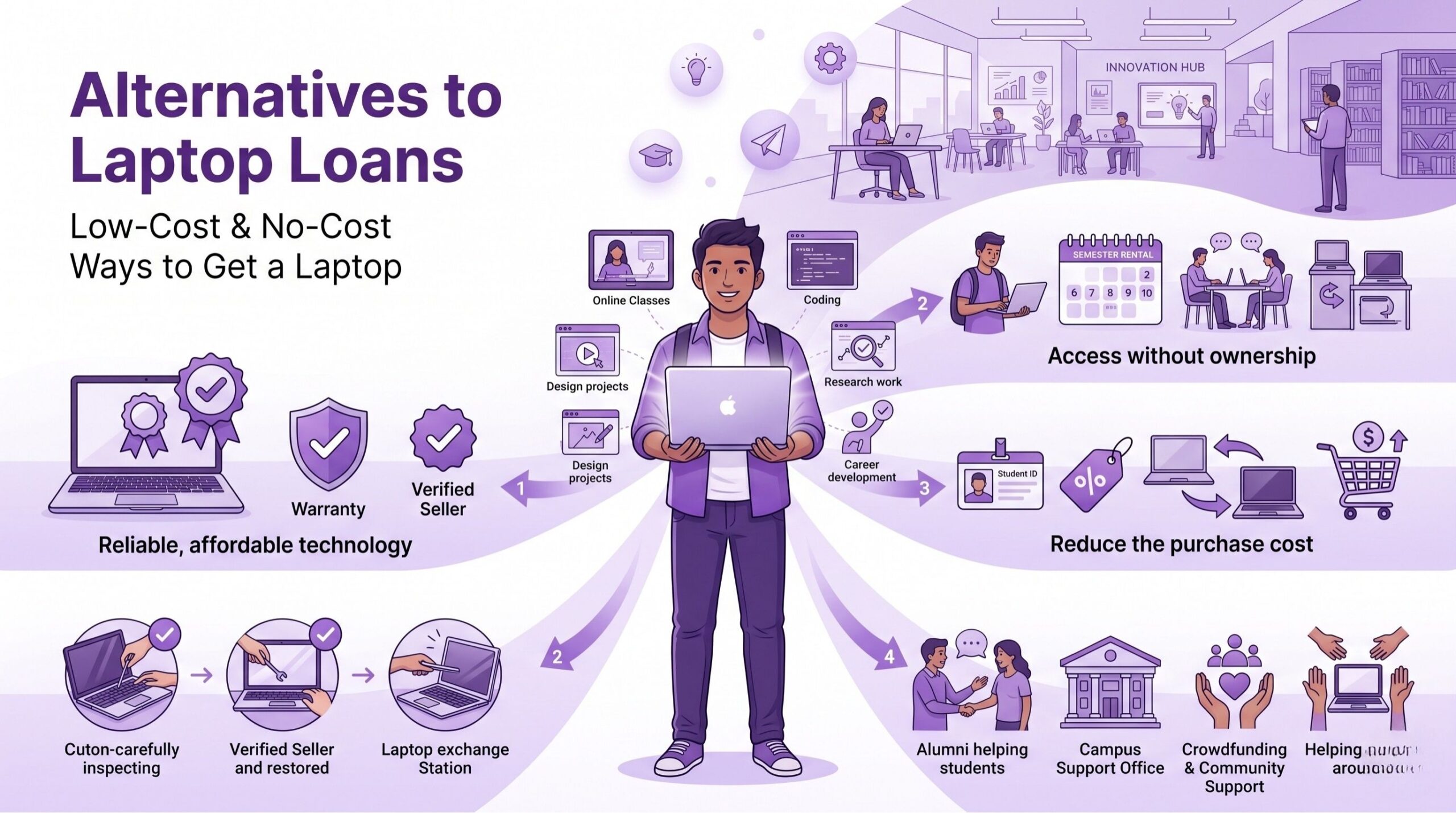
Alternatives to loans — low-cost and no-cost options
Refurbished and certified second-hand laptops — where to buy in India
Refurbished options already lower upfront cost by 30%–60%. Trusted platforms:
Amazon Renewed, Flipkart Refurbished, 2GUD, Cashify and ReGlobe.
Refurbished stores certified by brands (Dell outlet, Lenovo refurbished)
Perks: refurbished warranties, company certification and shipping windows. Check seller ratings, warranty period, and return policy before buying.
College rental, laptop-sharing and short-term rentals
Laptop rental is an option some universities and co-working providers offer in exchange for the semester or device sharing. Third-party companies have started offering monthly rental services (Rentomojo, Guppy, RentSher) for Laptops, and if you like it, you can extend or buy it later. Great for students looking for a loaner machine for just the semester or to work on a project.
Trade-in offers, buy-back programmes and student discounts (Flipkart, Amazon, Croma)
Trade-in: The offer requires you to deliver any aged devices to Flipkart or Amazon and receive a discount on a new purchase against them via Flipkart or brand retail stores.
On a student discount: Microsoft, Apple, and many brands offer education discounts with a student card. Croma and other brand stores offer periodic student sale incentives, including EMI options and discounts. Stack trade-in + student discounts to reduce the overall net outlay significantly.
Crowdfunded and campus funds+alumni support
Crowdfunding: One may consider platforms like Ketto or Milaap for education-related needs, but success depends on how well you write your story and the strength of your network deliverable.
Campus funds: Some colleges retain hardship funds or alumni-run benevolent funds to help needy students with equipment purchase. Go to the college finance or student support office with a letter.
Protecting your investment: insurance, warranties and maintenance
What do laptop insurance policies in India cover, and how to file a claim?
Accidental damage, theft (optional), liquid damage, and, in some cases, out-of-warranty breakdowns are typically covered by laptop insurance. Device-specific Policies: Provided by insurers (Tata AIG, Bajaj Allianz, Digit, OneAssist).
Steps:
Purchase as part of the Warranty or at the specialty purchase checkout
Issued invoice and policy documents, registering with the serial number.
Register the claims either online or by phone, upload high-resolution photos along with the Police FIR for theft (if applicable), and either inspect the device or opt for cashless repairs. Note the deductibles to be paid, exclusions (like intentional damage) and claim limits.
Warranty extension, protect against accidental damage, service laboratories
Extended Warranty: Covers parts and defects on sites outside of the original manufacturer’s warranty. Typically includes hardware failures but does not cover accidental damage.
Accidental Damage Protection (ADP): This cover against drops, spills and screen cracks can only be added as a bundled plan when you place your order or via third-party insurers.
Service centres: Focus on OEM-certified service centres, genuine parts, turnaround time and pickup
Backup and security best practices (educational apps)
Backup: cloud-based (Google Drive, OneDrive) and periodic local backup (external HDD/SSD for project files).
Security: Full-disk encryption, strong password policy, use VPN on public Wi-Fi, keep OS/software up to date.
Training apps: Maintain licensed and institutionally subscribed apps — record Git-based IDEs and project repositories with backups on GitHub/Bitbucket for code safekeeping.
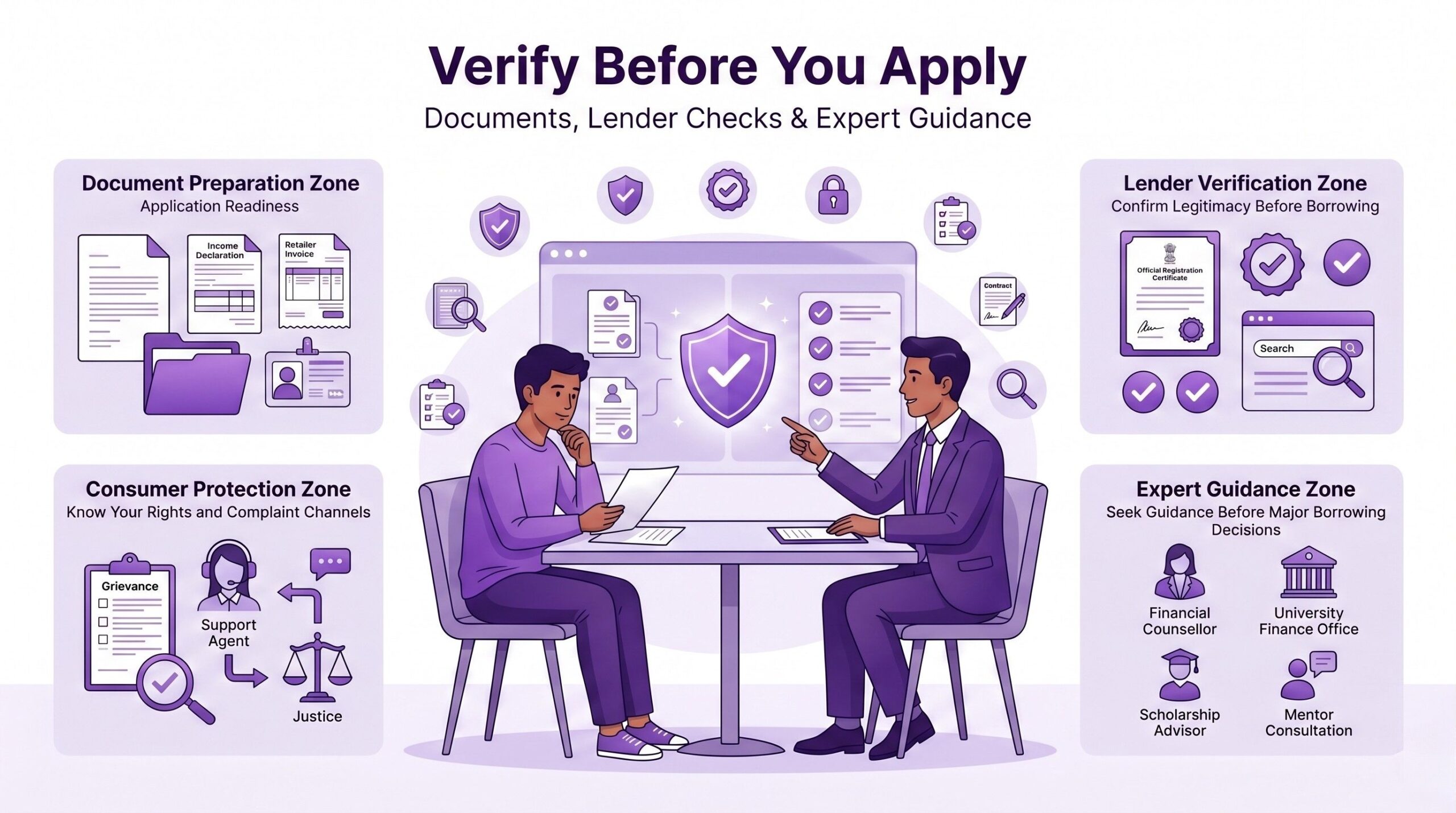
Credibility — documents, expert quotes and how to verify lenders
Recommended document samples and bank templates
Prepare templates for:
- Letter of purpose (Loan application cover letter for laptop purchase)
- Income statement/guarantor declaration: employer name, designation, monthly income and a provision to be a co-applicant.
- Proforma invoice template from Retailer with product detail, price breakup and GST.
Banks/NBFCs usually have sanction letter and loan agreement formats available for download — ask for a sample to review the terms before signing.
How to check lender registration, RBI approvals and customer grievance redressal
Public banks: provide a list on government portals, check the branch contact details for each bank, and standard education loan product brochures.
NBFCs/Fintech: Only check for lender registration if they are a registered NBFC or a peer-to-peer (P2P) lender, as per the RBI’s website. Check that the NBFC registration number and the lender’s address are valid.
Customer grievance: Lenders need to have a nodal officer and a grievance redressal mechanism, with details of which available on the company website; if complaints remain unresolved, customers can escalate them to either the banking ombudsperson or the RBI.
When to consult a financial counsellor or college finance office
For long-term repayment capacity, compare multiple offers or borrow above ₹1–2 lakh; see a financial counsellor.
Individual colleges say finance offices can assist with scholarship applications, campus tie-ups or emergency grants. They may also clarify doubts on which schemes vendors are the best eligible for and share lists of vetted vendors.
Recommended steps and quick action plan for Indian students
7-step checklist to get a laptop loan quickly and safely
- Define exact need and budget: list software, specs and accessories.
- Check campus/vendor discounts: student pricing and 0% EMI offers first.
- Compare loan options: education loan, equipment cover, personal loan, NBFC and vendor EMI — compute EIR.
- Prepare the documents: admission proof, ID, proof of co-applicant’s income, and a pro forma invoice.
- Secure a co-applicant or collateral, if needed, to lower the rate.
- Read sanction letter: ensure “laptop/equipment” is explicitly covered and check moratorium/prepayment terms.
- Buy insurance/ADP and register warranty; keep invoices for loan records.
Touch Points: banks, college aid, certified dealers
BANKS: Go to an SBI, PNB or any private bank of your choice for education loan products.
NBFCs/Fintech: Bajaj Finserv, Tata Capital, KreditBee or campus fintech tie-ups for fast options.
College financing assistance: Usher the storehouse to grant up, mighty emergency funds of bud and vendor replacements
Certified Vendors: Opt for brand showrooms or certified refurbished channels with documented warranties.
A final tip is to look at the total cost, not just what you are comfortable with on a monthly basis. A low EMI may look appealing, but it often comes with hidden charges or a long tenure, making it much more expensive. Use vendor offers, scholarships and refurbished options where possible. If you go with a loan option, take it and write everything down to help minimize defaults and keep credit history clean. Be sure to leave something in savings.