


Download StuCred.
The Real Time Student Credit App.

Student Loans with Low Interest Rates in India
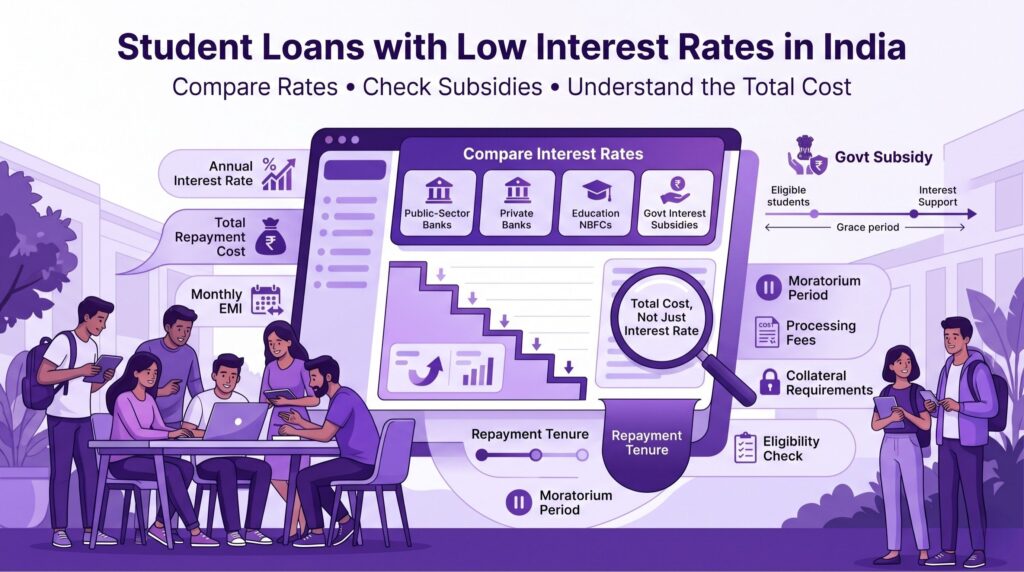
Understanding Student Loan Interest Rates in India
What is an interest rate vs. APR vs. processing fees
Interest rate: The nominal annual percentage a lender charges on the outstanding principal. This is typically quoted as X% per annum (ex: 9.5% p.a.) for education loans in India.
APR (Annual Percentage Rate): A more comprehensive measure that includes the interest rate plus most mandatory fees (processing fees, certain administration charges), expressed as an annual percentage. This makes APR a better indicator of the real annual cost of borrowing.
Processing fees: A one-time fee you pay lenders to underwrite your loan. These are typically a flat rate or small fraction of the loan (0.5%–1.5%). While the stated interest rate may seem low, upfront processing fees raise upfront costs and affect the effective APR.
Why it matters: Two lenders can quote similar interest rates, but differing processing fees, EMI structures, and other charges can make one loan significantly more expensive. Always compare APR or effective cost, not just headline interest.
Read more
Types of interest calculation: simple interest, compound interest, reducing balance
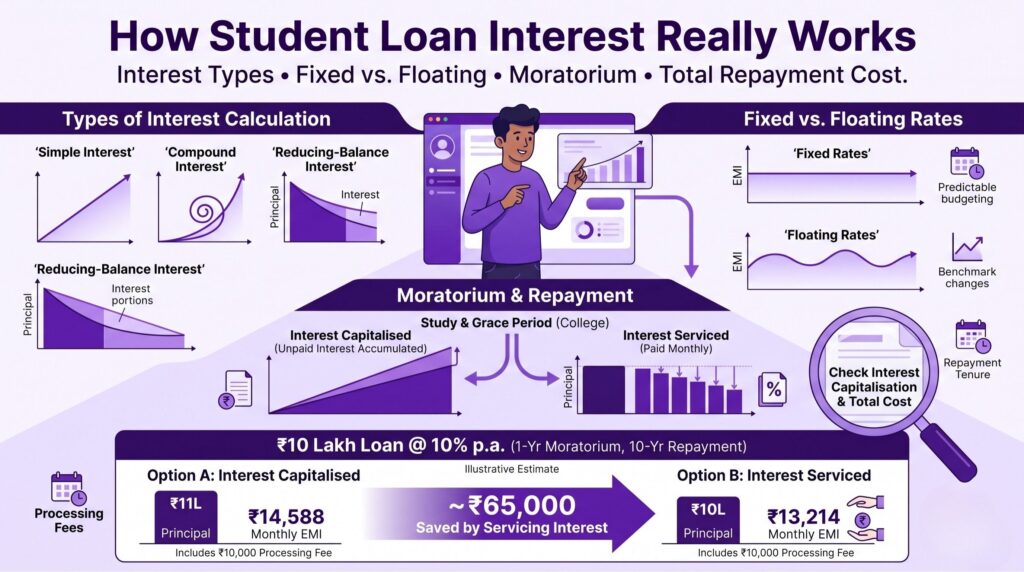
Simple interest: Charged over the principal amount for the loan tenure. Uncommon for long-term education loans but may come for short-term disbursals.
Compound Interest: Interest on principal plus all interest earned to date. This can significantly inflate costs when interest capitalises during a moratorium, or penalties are added to the interest.
Reducing balance (most popular for education loans): Interest is charged on the remaining principal after every EMI payment. As the principal falls, the interest component decreases. This format results in less total interest charged (compared to flat-rate or simple interest on full tenure)
Fixed vs. floating interest rates — pros and cons for students
Fixed interest rate:
Pros: Fixed EMI during the fixed tenure, easier budgeting, and protection against rate hikes.
Cons: The initial rate is usually higher than a floating-rate mortgage, and it offers less flexibility if market rates continue to decline.
Ideal for: Borrowers with a low-risk appetite who prefer their EMIs to be predictable
Floating interest rate:
Pros: Often low; when benchmark rates drop, EMIs/interest can fall too.
Cons: Vulnerable to repo rate hikes or lender margin changes; EMI volatility can complicate budgeting.
Best for: Borrowers who can absorb short-term payment fluctuations and plan to refinance soon.
How interest is charged during moratorium and repayment periods
Moratorium period: An average education loan moratorium lasts until course completion, plus a grace period (6–12 months). Treatment of interest differs:
Interest not paid during moratorium (capitalised): Interest accrues and gets added to principal when repayments begin. This adds to the amount borrowed and ultimately total interest paid following graduation.
Interest serviced during moratorium: If the borrower/co-applicant services interest during the moratorium, the outstanding principal is lower, which reduces the total cost.
Repayment period: EMI repayment begins after the moratorium. Depending on whether interest was capitalised, EMIs may be higher. Understand whether your lender capitalises moratorium interest, and plan to pay at least interest if feasible.
Impact of interest on total loan cost
Scenario: Rs. 10 lakh education loan for a 5-year course, 1-year moratorium, 10-year repayment, quoted interest 10% p.a., reducing balance, processing fee 1% (Rs. 10,000).
Option A: Don’t pay interest during moratorium (interest capitalised)
Interest during moratorium: 1 year of interest on the disbursed principal (approx. Rs. 1,00,000) is added to the principal, making the principal ~Rs. 11,00,000.
EMI on Rs. 11,00,000 for 10 years at 10% p.a. ≈ Rs. 14,588/month.
Total paid = EMI * 120 + processing fee ≈ Rs. 17,50,560 + Rs. 10,000 = Rs. 17,60,560.
Total interest paid ≈ Rs. 7,60,560.
Option B: Pay interest during moratorium (only interest payments)
Monthly interest during moratorium: (10%/12)*10,00,000 ≈ Rs. 8,333 x 12 = Rs. 1,00,000.
Principal stays Rs. 10,00,000. EMI for 10 years ≈ Rs. 13,214/month.
Total paid = (Interest during moratorium Rs.1,00,000) + EMI*120 (≈ Rs.15,85,680) + processing fee ≈ Rs. 16,95,680.
Total interest paid ≈ Rs. 6,95,680.
Difference: The borrower saves Rs. 65,000 by servicing interest during the moratorium in this illustration. Small actions during the moratorium yield big savings, particularly on larger loan tickets and longer-tenor loans.
Takeaway: Always check and confirm whether interest is capitalised during the moratorium. For this reason, whenever possible, pay moratorium interest to avoid interest on interest and a higher total cost. Estimate your EMI and total interest using the reducing-balance principle & realistic tenure; always include a processing fee while comparing APRs.
Who Offers Low-Interest Student Loans in India
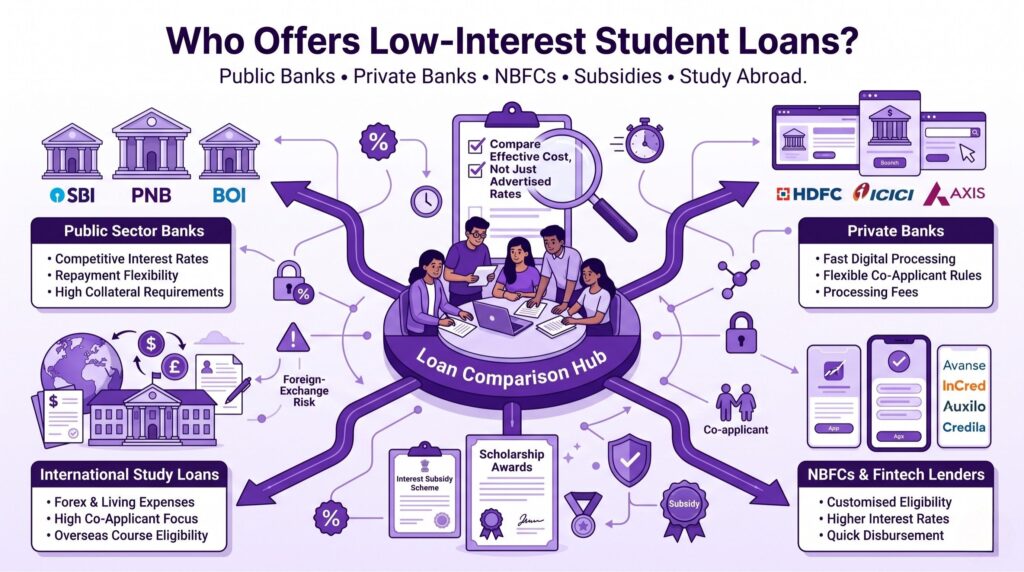
Public sector banks and their concessional schemes (SBI, PNB, BOI examples)
State Bank of India (SBI): SBI Student Loan scheme and SBI Global Ed-Vantage for higher studies abroad at competitive rates are among the country’s main education loan providers. SBI rates are usually linked to external benchmark-linked lending rates (EBLR) or MCLR; it also offers concessional education loans and scholarships for meritorious students.
Punjab National Bank (PNB): To encourage studies for Indian nationals at overseas and domestic levels, PNB UBI VIDYA has been introduced, under which it offers education loans along with special concessions to meritorious students, as well as other options such as the Government-guaranteed loan scheme. Rates are usually at least as competitive as peers in the public market, and sometimes cheaper where government subsidy schemes apply.
Bank of India (BOI) and other public sector banks have been offering loans under a standardised “Education Loan” product with features like margin waiver up to certain limits, collateral-free loans up to subsidised limits (e.g Rs. 7.5 lakh under many schemes ), interest concessions for borrowers covered under central/state subsidy programs, etc.;
Why public banks can be cheap:
- Lower margin bleed due to backing and scale.
- Interest rates for eligible borrowers are lower because of participation in various central subsidy-based schemes.
- Collateral-free limits offered at negligible cost under government guarantee schemes are available for small-ticket loans.
Private banks with competitive education loan rates (HDFC, ICICI, Axis)
HDFC Bank: Educational loans for studying abroad with competitive pricing, flexible repayment tenors, and relationship benefits (premium clients get cheaper rates). HDFC’s documentation and disbursal are comparatively quicker.
ICICI Bank: A major player in the education loan space for domestic and international programs, often with digital application processing and customised repayment plans. Salaried co-applicants with good credit may also get lower processing fees or rate discounts.
Axis Bank: Offers education loans with multiple features—fixed/floating rate options, home document collection, and periodic rate discounts for loyal customers.
Why private banks may be attractive:
- Quick Processing and enhanced customer service.
- Seat flexibility and digital interface.
- Introductory competitive rates or rate discounts linked to account relationships
Non-banking financial companies (NBFCs) and fintech lenders — when they are cheaper
NBFCs / Fintech lenders: Avanse, Incred, Auxilo, and Credila (although partially owned by banks or other NBFCs) are education loan companies that primarily offer high-ticket study loans and regularly cater to specific requirements for study abroad, vocational, and professional courses.
When NBFCs are cheaper:
No traditional co-applicant is required, and if disbursal must be immediate, flexible underwriting can offer a competitive interest rate.
NBFCs may price differently where collateral isn’t available (e.g., smaller ticket sizes), and, at times, match bank risk.
Trade-offs: NBFCs may charge slightly higher processing fees or impose tighter prepayment conditions. Look for RBI registration and read user reviews before selecting.
Government-backed schemes, scholarships and state education loans (PM Scholarship, state-specific funds)
Central schemes:
Government interest subvention programs (e.g., earlier models like Central Sector Interest Subsidy) reduce the effective rate for meritorious/SC/ST/OBC/EWS students for specified timelines.
Central scholarships (e.g., PM scholarship schemes) at institutions and elsewhere can cover ~20% of fees, which ultimately reduces loan size by increasing the amount without any interest component.
State-level schemes:
Several State Governments also run exclusive education loan funds or interest-subsidy schemes for students from economically weaker classes, as well as residents of States like Karnataka, Maharashtra, and Tamil Nadu. Such loans can offer significantly reduced MCLR rates or even subsidised EMIs.
How it reduces cost: Things like subsidies decrease the effective rate paid by the borrower (or even reduce principal outstanding), enabling smaller-margin loans to be offered for public banks.
International student loans for Indians studying abroad (foreign banks, specialised lenders)
Options for study abroad:
Indian banks (SBI Global Ed-Vantage, HDFC Credila, ICICI) and NBFCs that specialise in international education are common.
International banks: Some global banks or branches offer education loans to Indian students at competitive rates, often requiring a co-signer in the approved country (especially for riskier borrowers).
Niche lenders & marketplaces: Some niche players in the US/UK lend to international students through income-share agreements or university partnerships. This may also suit Indian students, who prefer loans with local-currency disbursal or FX-friendly structures.
Key considerations:
Currency risk: Loans denominated in a foreign currency expose the borrower to exchange-rate changes. Education loans (INR) in local currency remove FX risk, but might need cross-border fee disbursals.
Need for a co-signer: Most international loans require a local co-signer; an Indian lender may require an Indian co-applicant.
Compare effective cost: Consider interest, forex conversion charges, and guarantee fees.
Eligibility, Documents & Co-applicant Strategies to Lower Rate
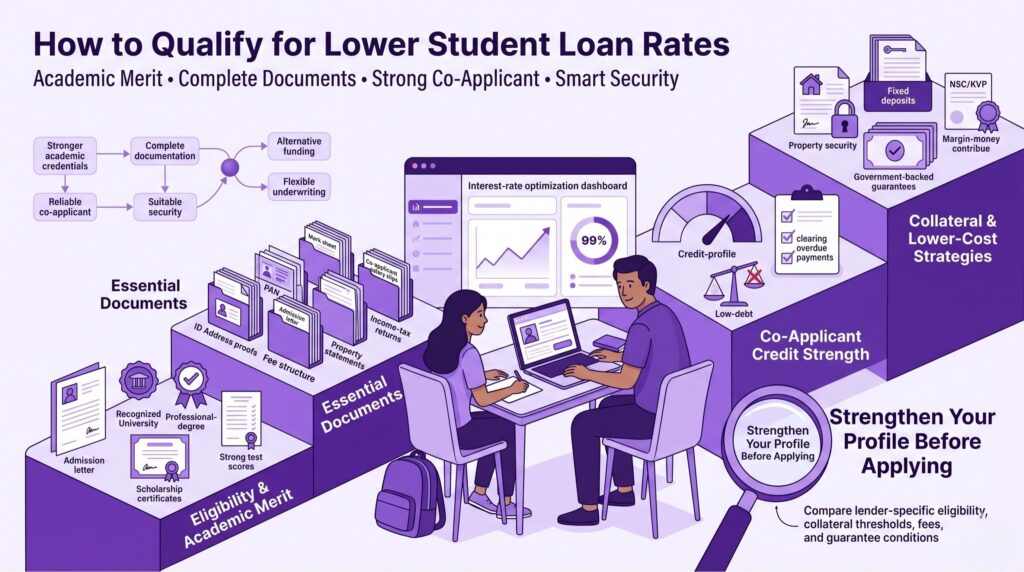
Typical eligibility criteria for concessional rates (course, institute, academic performance)
Regarding institute/course: The course’s value at an approved/recognised university, or whether it is a professional program or study at a top-ranked institution, determines the terms. Generally, lenders prefer institutions with strong placement records and predictable fee structures.
Degree courses and duration: Pricing often favours professional courses (MBA, engineering, medicine, MSc) because they offer high post-study earning potential. Higher rates may be charged for short-term vocational courses.
Academic performance: Merit-based scholarships, above-average test scores for GATE, CAT, GRE, GMAT, or top-quartile lists at your university can lead to lower rates and merit-based concessions under the lender’s scheme.
Loan size and tenor: Smaller ticket sizes with shorter tenors typically get better pricing; some lenders use sliding scales that reduce the margin for lower- and medium-risk loans.
Documents that matter: admission letter, fee structure, proof of income, collateral papers
Essential documents:
- Institute Offer/Admission letter and fee structure (compulsory).
- ID and Address Proof of Applicant & Co-Applicant (Aadhaar, PAN, Passport)
- Academic documents (mark sheets, certificates)
- Proof of income for co-applicant: salary slips, Form 16, bank statements/IT returns (last 2- 3 years)
- Security for Collateral or other documents like property title deed, bank FDs, NSC certificates
- Passport & visa for study abroad disbursals
Why these matter: Lenders judge repayment capacity mainly on the co-applicant’s income and its stability; good documentation speeds approval and may lead to lower interest.
Role of co-applicant (parents/guardian) credit profile and how it affects interest
Co-applicant impact:
The lender largely considers the co-applicant’s income, credit history, and current liabilities when determining risk and the interest margin.
Good salary, low DTI and high CIBIL → best slabs
Practical tips:
- Choose the co-applicant with the stronger credit profile (typically a parent with a stable government/salaried job).
- Review and clear any overdue records, and drop useless debts beforehand.
- Submit full IT returns and stability proof to establish repayment ability
Using collateral/security to access lower rates — margin money, mortgage, NSC/FD pledges
Threshold for Collateral-Free Loans: Lenders (public and private) allow collateral-free loans up to a statutory amount (generally Rs. 7.5 lakh or more). Lenders need tangible security for larger loans.
Forms of collateral:
Mortgage on Property: Margins are reduced, and improved rate slabs apply for secured loans.
Fixed deposits, NSC, KVP, or bank guarantees: Liquid assets reduce risk for the lender and can help you get lower interest rates.
Third-party guarantees: Some lenders approve a guarantee from a third party for the entire property or company, which can help reduce the margin.
Margin money: On certain loans, the lenders may require a contribution from the borrower/co-applicant (margin (5–15%)). For example, increasing the borrower’s upfront contribution lowers the loan-to-value and ultimately reduces the rate.
Strategies for students with weak co-applicant credit or no collateral
Options and tactics:
Target NBFCs/fintech lenders: Some focus on risk-based pricing and flexible underwriting and are experienced in lending without traditional collateral.
Use education loan guarantees: Depending on the country, government or third-party guarantee schemes may allow collateral-free lending up to a certain limit.
Use scholarships/fee waivers to your advantage: Show award letters to fix the loan amount and also enhance your risk profile.
Because you have a larger basket of loans with tangential lenders and are applying for large denominations, you will get a better tenor than conventional borrowers with smaller loans.
Share more documents: Underwriting can benefit from proof of placements, sponsor letters or an employment offer.
Co-borrower alternatives: Consider a working relative with good credit as a co-applicant instead of your parent without a job.
Build Credit: If time between decision and settlement is free, improve co-applicant credit score (reduce credit usage, repay credits) before applying.
How to Compare and Choose the Lowest-Cost Loan
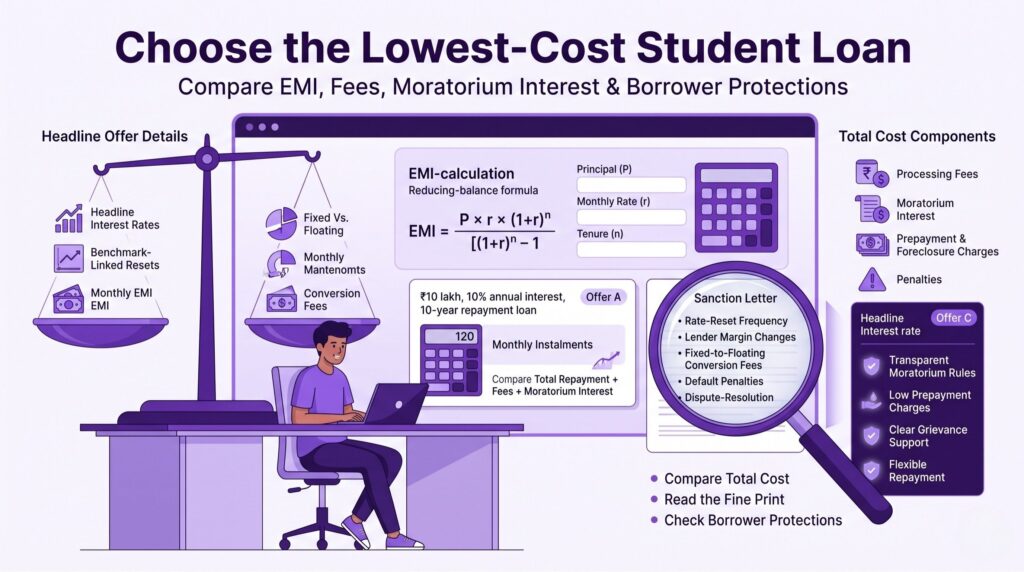
Comparing effective interest: rate, processing fee, prepayment charge, moratorium interest
The headline rate is only one component of the total cost: calculate effective cost with:
- Interest rate (fixed/floating) and benchmark-linked (MCLR/EBLR/RLLR)
- Processing fee and other high admin or processing charges
- Moratorium interest handling (whether capitalised or required to be paid)
- Prepayment/foreclosure penalties (far fewer lenders today allow partial without restrictions)
Calculating EMI and total cost across tenors — step-by-step formula and sample calculators
EMI formula (reducing balance): EMI = [P × r × (1+r)^n] / [(1+r)^n – 1]
– P = loan principal
– r = monthly interest rate (annual rate/12)
– n = total number of monthly instalments
Step-by-step:
- Convert annual interest to monthly (e.g., 10% p.a. → 0.10/12 = 0.008333)
- Choose tenor in months (e.g., 10 years → 120)
- Plug into formula or use an EMI calculator
Compare total cost:
- Total paid = EMI × n + processing fee + moratorium interest (if capitalised)
- Total interest = Total paid − Principal − processing fee
- Use the lender calculator and at least one third-party education loan EMI calculator in India to cross-check figures.
Reading the fine print: conversion clauses, reset margin, penalties
Common clauses to watch:
Conversion clause: Allows conversion from fixed to floating rate (or vice versa) but could incur fees/forms, etc.
Reset margin: Individual floating interest may reset during the loan term in line with its own floating rate; clarify frequency and trigger sequences
Fees for prepayment and foreclosure: Some lenders allow penalty-free prepayment after a specified period; others charge a minimum penalty of about 10%. Prepayment rules may vary for floating-rate loans.
Auto-renewals and defaults: Learn when accelerations and penalty interest rates for missed EMIs can be enforced, and how EMIs may need to be recalculated or adjusted for any rate changes.
Always request a copy of the sanction letter and standard terms & conditions, and read clauses about interest resets, fees, and dispute resolution.
When a slightly higher rate but better borrower protections is preferable
Consider superior borrower protections:
- Transparent moratorium rules (zero interest capitalisation),
- No or low prepayment penalties
- Effective grievance redressal and speedy loan settlement process
- Benefits to relationship (discounting rate for salary account / first payment on time)
Lower total cost and penalty-free prepayment on a loan with a marginally higher headline rate, or hidden charges that stick around on large loan amounts, are hard to beat unless the lender offers subsidised pass-through. Consider total cost under realistic repayment scenarios; select the loan that minimises uncertainty and legal risk.
Negotiation & Rate Reduction Tactics
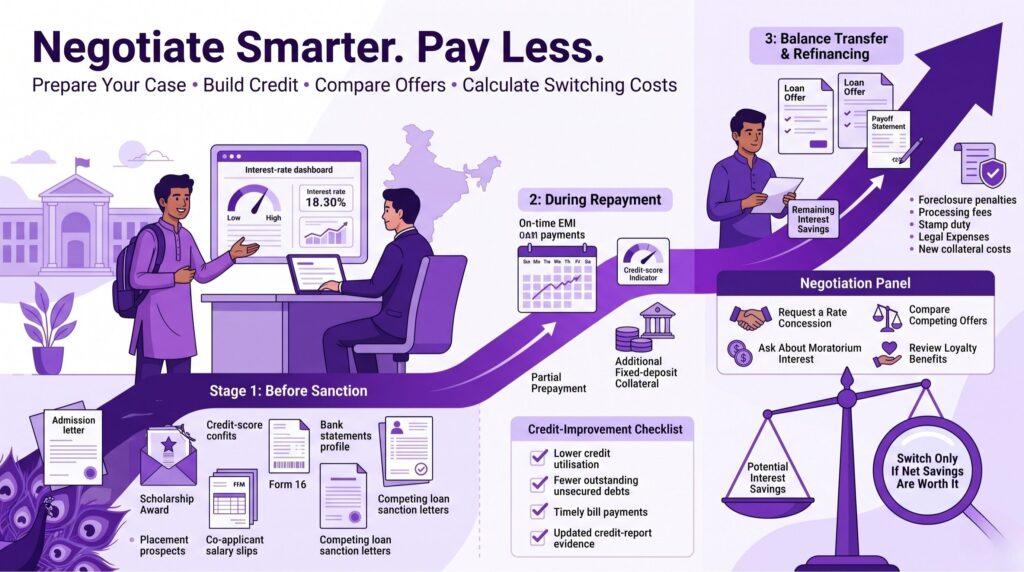
Negotiate with the banks before sanction: Use admission to a good institute, scholarship or strength of co-applicant
Come prepared:
- Demonstrate admission to good universities, letters of scholarship offer and the types of placements we can expect.
- Submit good co-applicant documents (salary slip, Form 16, bank statements, existing relationship with the bank).
Negotiation points:
Request a rate slab reduction considering the co-applicant score or salary grade (If applicable)
Ask for concession for moratorium interest (Can the interest portion be serviced during moratorium at reduced rate)
Use competition:
Submit competing sanction letters and ask the bank to match/beat the offer
Unlock the best pricing from the bank if they are a university partner or own an alum programme with the institution.
Availing rate cuts during loan repayment: Timely payment of EMIs, prepayment and improving the relationship with the bank
On-time payments matter:
Share your regular EMI payments and no-default record to apply for a lower rate.
Relationship upgrade:
- Pool savings or salary accounts with the lender to qualify for loyalty bonuses.
- Top up Collateral/FDs to re-negotiate margins.
Prepayment behaviour:
Lenders often view the risk as lower if you make larger prepayments and reduce the loan-to-value.
Balance transfer/refinance options and how to evaluate switching costs
When to consider balance transfer:
- After taking the loan, you find a significantly lower interest rate elsewhere.
- You may have a better credit score and financial profile.
Evaluate switching costs:
- Penalties on foreclosures/part-prepayments from the current lender
- Processing fees, stamp duty, or legal costs at the lending company that receives the loan
New collateral/documentation costs
Time and effort: Balance transfers may only be worth it if the net present value of savings exceeds switching costs.
Checklist before switching:
- Get a payoff statement including all amounts owed and foreclosure fees.
- Remaining interest difference (current loan vs. proposed loan) over remaining tenor
- No hidden clauses that reset margin payouts
- Renegotiating or refinancing with credit score improvements
Improve credit score tactics:
- Cut back or cancel credit cards with high usage.
- If possible, pitch in to pay off all small unsecured loans or restructure.
- Pay EMIs and bills on time, every time.
Once improved:
- Approach the lender with a formal request, including proof of your credit report and details of your employment upgrade.
- If the lender won’t lower the rate, secure plenty of refinance offers and use them as leverage.
Special Cases: Low-Interest Options for Specific Needs
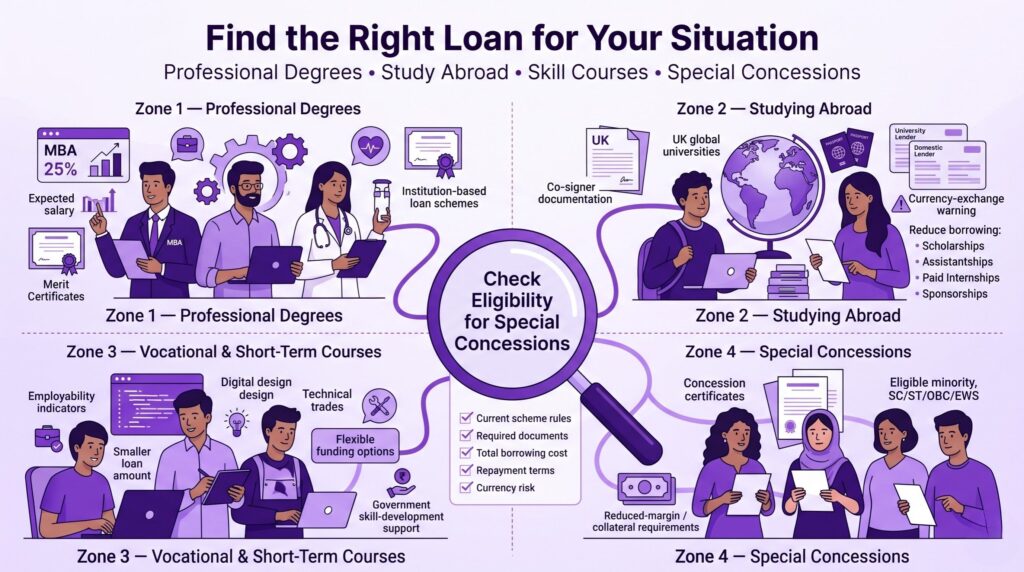
Loans for MBA, engineering, medicine — branch-specific lender schemes
MBA: Several banks and NBFCs offer specialised MBA education loan packages tied to high placement & salary opportunities. As a result, these loans often carry higher pricing due to longer durations and moratoriums.
Engineering & Medicine: Specialised schemes and public banks primarily offer loans for technical/medical courses, often with interest concessions for top-merit students or institutions
Tip: Use past placement statistics or expected median salary during negotiation for professional courses to get a better deal
Loan options for study abroad (UK, US, Australia, Canada) with lower interest alternatives
Domestic lenders with products available internationally:
Some lenders offer study abroad solutions with forex-neutral disbursals (always solely in INR) at really good rates.
Compare SBI Global Ed-Vantage, HDFC Credila, Auxilo, and Avanse for the lowest interest education loan.
Foreign lenders:
US Loans may be competitive for some students with a US-based co-signer, but there is currency risk and a need for a co-signer
Cheaper alternatives:
Scholarships, university assistantships, and paid internships can help reduce the loan amount.
Employer sponsorships or international education loan marketplaces may be better priced.
Loans for vocational and short-term courses — where interest tends to be higher/lower
Short-term/vocational programs often have:
Uncertain post-course earnings may mean higher interest or shorter tenors, as lenders perceive greater risk.
Some NBFCs specialise in these loans and can offer customised products at competitive rates, especially if the program has reasonable employability outcomes.
Search for lenders offering small loans or government grants focused on skill development, as these often have lower rates.
Women students, minorities and reserved categories — special concessions and lower rates
Concessions available:
Certain banks and state schemes offer special interest-discount schemes for female borrowers, minority communities, and SC/ST/OBC/EWS categories.
Women-centric loans may have lower margins or reduced collateral requirements.
Actionable steps:
Explore central and state government pages for active rebates.
When applying, you must provide caste or gender documentation to the lender to avail a concession.
Government Schemes, Subsidies & Interest Concessions
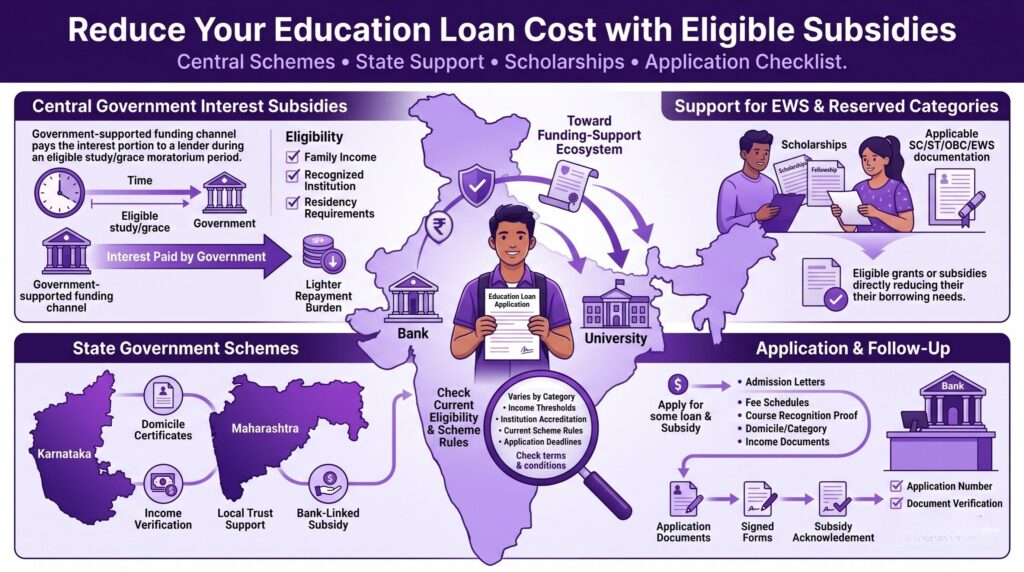
Central government interest subsidy schemes for meritorious students (how they work)
Overview:
Interest subsidy schemes usually cover interest in full or partially for a moratorium period or a specified time frame, making it easier for borrowers.
Entry into the system usually depends on an earnings cap, admission to eligible institutions, and nationality/residency requirements.
How they operate:
The interest is paid to the lender either during the moratorium or for a specific period after disbursement by the central government (or a nodal agency). During that period, the borrower repays the principal or pays a lower EMI.
Effect:
Reduces the effective rate substantially for eligible students and improves affordability.
State government low-interest education loans and eligibility (examples: Karnataka, Maharashtra)
Karnataka: One of the series of state-based education loan schemes. The Interest Subsidy Scheme covers loans for study after Higher Secondary (+2), anywhere in India, for deserving candidates who cannot afford interest from their family salary, up to Rs 200,000; concessional rates are provided.
Maharashtra Offers education loan schemes and subsidies through state development corporations, which are implemented through banks.
Eligibility differs:
For example, they typically require domicile, minimum income thresholds, confirmation of admission, and compliance with documentation standards.
Local advantages:
Central schemes are not enough; national programs are often complemented by state initiatives, particularly those focused on marginalised sections.
Schemes for students from economically weaker sections and reserved categories
Special schemes:
10% reserved fund for SC/ST/OBC/EWS, which usually has a subsidised rate or an interest-free period.
Scholarships and fellowships lower the principal on average and reduce borrowing costs.
Application nuances:
You need to submit caste/EWS/BC certificates and income proofs to get benefits.
How to apply and documents required for subsidy claims
Typical steps:
The process consists of applying for the education loan and, at the same time, applying for the subsidy via an agency (Usually a bank)
Provide Admission Offer, fee schedule, domicile/reservation certificates, proof of income and other such affidavits as might be prescribed.
Documentation:
Duly filled and signed application forms; photocopies of admission letters (if issued); income certificate; caste reservation/proof; copy of course recognition; and bank-specific forms.
Follow-up:
Keep copies of sanction letters and subsidy claim acknowledgements; follow up regularly with the bank’s subsidy processing desk to confirm when your subsidy will be credited.
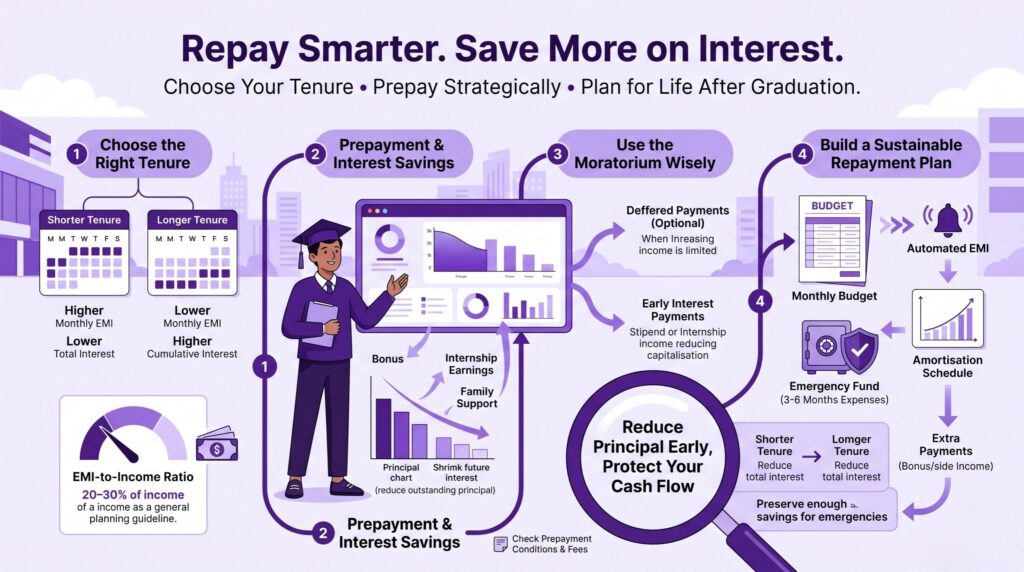
Repayment Planning to Minimise Interest Cost
Choosing optimal tenor: balancing EMI affordability vs total interest
Shorter tenor:
Advantages: Lower overall interest, Faster debt pay-off
Disadvantages: Higher EMI, may put pressure on cash flow
Longer tenor:
Monthly EMI is lower; cash flow management becomes easier.
Cons: More total interest; Longer repayment period
Strategy:
Compare EMIs for multiple tenors and simulate post-graduation income scenarios. Aim for a comfortable EMI-to-salary ratio (commonly 20–30% in early career) while minimising extra interest.
Prepayment and part-prepayment: frequency, penalties and impact on interest saved
Prepayment effect:
Prepayments reduce the principal, which decreases future interest and may reduce EMIs or tenure.
Frequency:
Lenders may also base penalties on how many EMIs you have made, allowing a small number of penalty-free early repayments and charging only for partial-adjustment prepayment. Read the loan terms.
Penalties:
Most public banks charge low or no prepayment fees on floating-rate loans; fixed-rate products may charge a fee.
Practical tip:
Ad-hoc lump-sum prepayments — lump-sum prepayments when you receive bonuses, parental support, or a graduate placement bonus. For the highest interest savings, always shorten tenure and don’t reduce EMI on prepayments.
Using moratorium smartly: when to defer and when to start repayment early
Defer when:
You truly have no income and could not even make interest payments
You are in a low-stipend internship or research program where EMIs at this stage will cause distress.
Start early when:
If you earn from internships, part-time work, or receive a stipend from family, paying at least the interest avoids capitalisation.
Paying in advance reduces compounding and total interest.
Recommendation:
If at all possible, pay moratorium interest every month. This avoids interest on interest and considerably reduces the total cost.
Building a post-graduation repayment plan: budgeting, emergency fund, accelerated payments
Create a realistic budget:
Prioritise EMIs, essentials and some reserve (3–6 months of expenses).
Emergency fund:
Prevents missed EMIs during income shocks, safeguards your credit score, and avoids penalty interest.
Accelerated payments:
Whenever you get a bonus or other side income, use it to clear lumps beforehand. If you track everything and think extra payments could tempt you to spend, consider automating them.
Monitor progress:
Keep an amortisation table and monitor principal pay-down over time
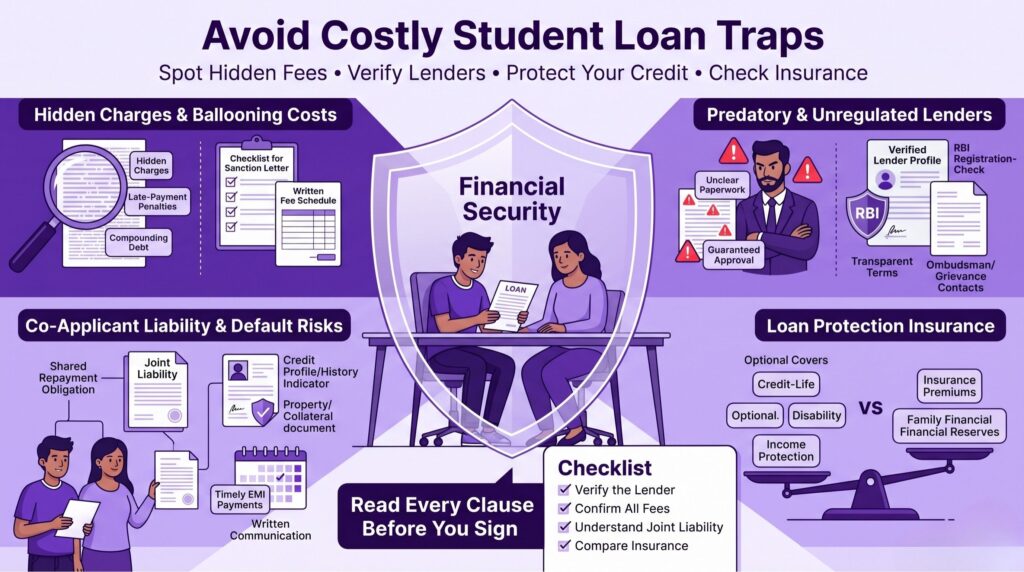
Risks, Pitfalls and How to Avoid Loan Traps
Hidden charges and ballooning costs: penalties, rollover interest, compound effects
Watch out for:
- Processing charges and service tax on fees are hidden
- Higher penalties in case of late payment (usually far higher than standard EMIs)
- Credit card companies earn money through things such as: – Compound interest (interest-on-interest—delayed payments add up)
Prevention:
Obtain a full fee schedule and get written confirmation of all fees involved in the letter of sanction.
Beware of predatory NBFCs and unregulated lenders — red flags
Red flags:
No RBI registration, opaque documentation, aggressive doorstep sales, demand for cash bribes, or promises of guaranteed approvals without adequate paperwork.
High processing fees, hidden penalty clauses, or prepayment penalties that lock you in.
How to verify:
Look up the lender’s RBI ID, Verify Customer Reviews (if permitted), ask for Written Terms and Conditions, and avoid lenders that are not available in person or do not provide a clear grievance follow-up.
Liability of a co-applicant or the legal consequences of default: India
Co-applicant liability and legal consequences of default in India
Co-applicants (usually parents) are jointly and severally responsible. Default can affect both credit histories, and consequences may include collection calls, legal action, or recovery of collateral.
Legal consequences:
Lenders can recover loans by issuing notices, filing a lawsuit, or auctioning the mortgaged security.
Advice:
Be aware of the impact on joint liability, assess how involved the co-applicant is, and make sure you keep paying on time so your household credit health doesn’t suffer.
Insurance and loan protection options — are they worth it?
Insurance and loan protection options — do they make sense?
Credit-life insurance, accidental death and disability cover, or unemployment protection may be offered.
Pros:
Protects borrower/co-applicant from income shock and loan default arising from death/critical illness
Cons:
Can make loan overall expensive; some insurances might include exclusions or have low claim ratios.
Recommendation:
Analyse premium compared to coverage. A specific insurance policy can make sense for higher-balance loans lacking family buffers; avoid lender-mandated opaque insurance.
FAQs
Which Indian bank offers the lowest interest on education loan?
Rates change regularly, and there is no single answer: In the low-cost loan space, several public sector banks (e.g., SBI, PNB) and specialised NBFCs offered competitive, attractive slabs; however, post-subsidy effective APRs remained significantly lower. The lowest effective rate will usually be determined by collateral, borrower profile, co-applicant strength and available subsidies.
How to find the current lowest rate:
- Compare APRs SBI (Global Ed-Vantage), PNB, HDFC, ICICI and other top NBFCs (Credila, Avanse)
- Factor processing fees, moratorium interest policy and prepayment charges;
- Check the latest rates using lenders’ rate comparison tools or third-party education loan aggregator sites.
How to get an education loan without a co-applicant in India?
Options:
If the student has strong collateral, an excellent academic background, or a well-paid job offer/scholarship, some lenders and NBFCs provide education loans without a co-applicant.
For study abroad, certain foreign lenders accept a local co-signer or use university partnerships.
Practical steps:
- Show significant collateral (property or FD), scholarship letters, or prove future income (job offers).
- Look at specialised NBFCs or fintech lenders that have written such loans.
- Prepare for increased scrutiny and potentially higher rates; compare the total cost against the competition.
Is it better to take a loan from an NBFC or a bank for study abroad?
Bank advantages:
Lower rates for propensity-based borrowers; improved pass-through across the board; large branch network with predictable grievance channels.
NBFC advantages:
Faster underwriting, flexible paperwork, and product innovation tailored for international tuition disbursement.
Decision factors:
Credit profile, urgency, collateral availability, and the cost of foreign currency disbursements. Banks have the lowest effective costs if your application is strong, while NBFCs can be better if you need flexibility or don’t have standard co-applicant credentials.
How does moratorium interest work and do you pay interest during study?
Moratorium interest explained:
While studying, the EMIs are deferred. Lenders grant a moratorium. Interest can either be rolled up (added to the principal) or payable monthly.
Do you pay?
If you don’t service interest during the moratorium, it usually gets added to your loan, raising the total cost. During the moratorium, you should pay at least the interest (if possible) so it doesn’t capitalise.
Check with lender:
Confirm whether the lender capitalises moratorium interest and whether you can opt to pay only the interest during that period.
Can I prepay an education loan and what are the charges?
Yes, prepayment or partial repayment is allowed by most lenders.
Charges:
Floating-rate loans in many cases can be prepaid without penalty, while fixed-rate loans could incur a prepayment fee.
NBFCs may have their own prepayment rules—some allow partial prepayment anytime while others stipulate a minimum prepayment amount and charge a fee.
Strategy:
If you get a lump sum, prepay to reduce the tenure instead of reducing the EMI for maximum interest savings. After making a repayment, always ask for the latest outstanding statement.
What documents prove course credibility to secure a lower rate?
Useful documents:
Official admission letter on institute letterhead with fee structure
Accreditation or recognition docs (AICTE, UGC, university accreditation); address and contact details
Placement reports (or median salary data where applicable) or scholarship/merit award letters
Proof of course curriculum/ duration
Why lenders care: High-employability, credible courses lower risk for lenders, making lending more attractive or even collateral-free lending possible.
Final note
Securing a low-interest education loan in India requires preparation: assemble clean documentation, understand moratorium implications, compare effective APRs, negotiate based on admission and co-applicant strength, and plan repayment proactively. Use state and central subsidy schemes where eligible, consider NBFCs for flexibility, and always check lender credentials before committing. With the right approach, you can minimise interest cost and focus on your studies and future career.