


Download StuCred.
The Real Time Student Credit App.

No-Interest Student Loans in India
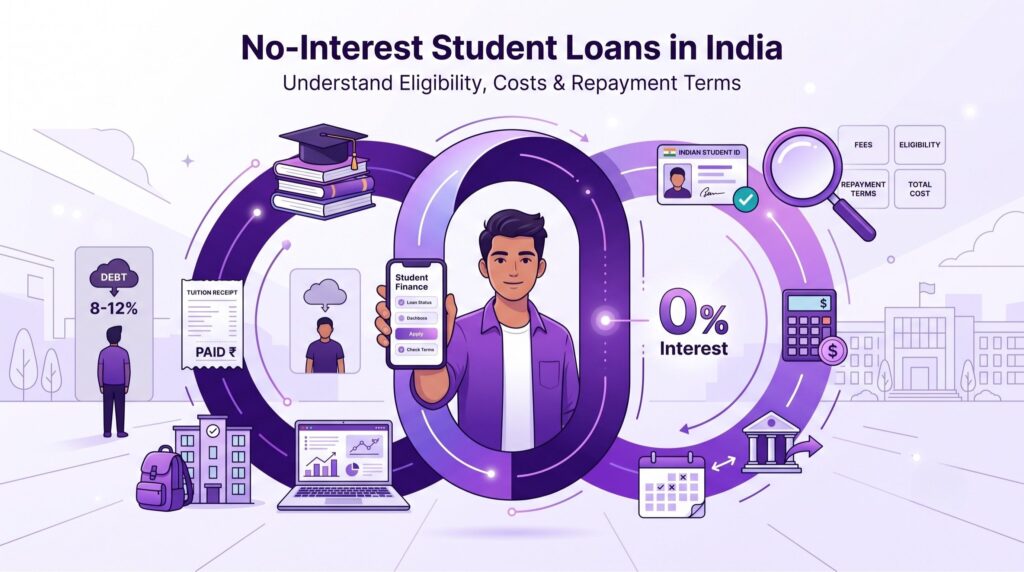
No-interest student loans—also called interest-free education loans or zero-interest student loans—are increasingly discussed by students, parents, NGOs, universities and fintech firms in India. As tuition and living costs rise and competition for scholarships remains steep, interest-free options offer an attractive way to fund studies without the long-term burden of interest. This guide explains what these schemes are, who offers them, how to apply, and practical strategies for repayment and protection.
This guide covers:
- Clearly defined terms: Why non-interest-based loans are not the same as either subsidised loans or scholarships
- Interest-free structures you may come across (zero-interest, moratorium-based waivers, short-term waivers)
- Who provides them: Government schemes, public-sector bank programmes, NGOs, trusts, CSR-funded schemes, and P2P and crowdfunding models.
- Who is eligible, documents & the application process, with helpful tips to expedite approval
- Comparison with subsidised loans, grants and EMI-based education loans
- Key programmes, trusts and fintech platforms to be aware of in India
- Credit, co-signers and security requirements, as well as default treatment
- Repayment options for students and families; legal/regulatory consumer protections
- 30 Day Action Plan & Templates to Apply NOW
You can explore many options, including an interest-free loan for your domestic professional course, strategy, short-term study expenses, and emergency assistance, and this guide has practical, India-centric data to help you assess these programs. Use only the sections relevant to you, and use the checklists and templates as instructed to increase your chances of success.
Read more
What are No Interest Student Loans?
Definition and how they differ from subsidised loans and scholarships
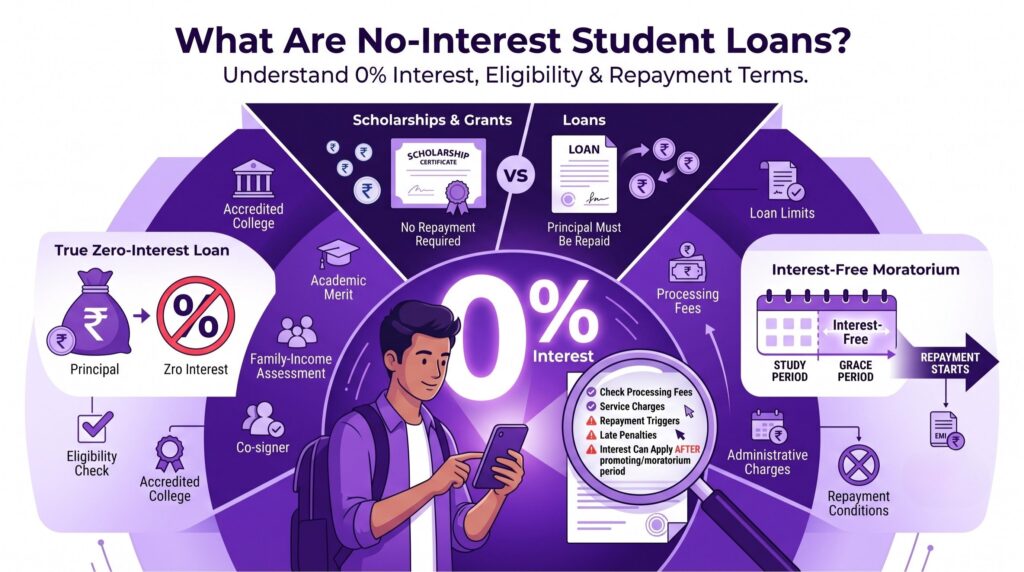
No-interest student loans (interest-free education loans, zero interest student loan) are funding arrangements in which the borrower does not pay interest on the loan principal during a set period. These loans are structured as free money; they do not accrue interest and compound by design, covering tuition, living or other study-related costs at little to no cost compared to traditional education loans.
They differ from:
Subsidised loans: In subsidised loans (these are mostly government-supported), the interest may be paid by a third party (e.g., from either the government or an institution) while you study (or if your moratorium period is continuing, and in that case would probably accrue once subsidies end, or such payment of interest has conditions attached). The borrower might have to pay at least some interest liability or higher fees.
Scholarships & Grants: are awards based on merit or need that do not have to be repaid. Interest-free loans must be paid back, while scholarships are harder to obtain and often limited in supply, but they provide financial support without borrowing.
Types: zero-interest, interest-free moratorium, short-term interest waiver
Zero-interest loans: A true zero-interest loan has no cost of borrowing for the life of the loan. These are rarer and generally offered through philanthropic trusts or as limited-duration mini-promotions run by fintech platforms for small amounts as a teaser.
Interest-free moratorium: Return 0% during the study period or an initial moratorium (e.g., course duration + 6 months). Once the moratorium is lifted, some schemes switch to subsidised interest rates at reduced costs or require repayment without additional interest. Government education subsidies sometimes work that way, too.
Interest waiver on short term: Lenders can provide interest-free periods (such as the first 6–12 months) to support students through their study period. Then, either a fee is applied, or the loan converts to a low-interest product.
Hybrid model: A small administrative fee and no interest, or an interest waiver only if the student meets performance milestones or secures employment.
Typical eligibility and basic terms to expect
Eligibility varies by provider, but common criteria include:
Course and institute accreditation: An accredited university, college, or recognised professional programme. Course validation/Pre approval is often needed for International study.
Academic merit: Min. marks, entrance test rank/acquisition of a recognised course.
Income or means-tested need: Based on a focus on economically weaker students and proof of family income.
Domicile/residence: Some state or local programs are limited to those who live in that state or locality.
Age or course level: From threshold to post-graduate vocation; most pathways focus on undergraduate study or vocational pathways.
Paperwork and co-signer: Proof of identity, admission letters, course fee structure, proof of salary (many times guarantor or collateral in case the amount is high)
Basic terms you should expect in interest-free offers:
Loan Amount Limits: Interest-free deals often cap the amount per student, usually covering only part of tuition/living expenses rather than full international fees.
Tenure and repayment schedule: Start of repayment (currently, after course, moratorium), EMI amounts (if any) and maximum tenure.
Processing /Administrative charges: Zero-interest loans may have a non-refundable processing fee or service charge of only a nominal amount.
Conditions and covenants: Placement filing or usage limitations (for example, tuition only).
Defaults and penalties: Late fees, collection measures and possible qualification as an interest-bearing account following delinquency.
How repayment and administrative fees usually work in interest-free schemes.
In an interest-free scheme, you repay principal, not interest. Common features:
EMIs with principal only: Repayments gradually reduce the principal, and total repayment equals the principal plus any administrative or processing fees.
Zero Interest instead of service charges: Some providers charge an upfront fee (flat or percentage) that is deducted upfront or added to the principal amount at signing. Then come annual maintenance costs and even the expense of signing documentation.
Income-contingent or deferred repayments: These philanthropic or CSR loans allow post-study repayments (e.g., a percentage of salary), placing no burden on the student while still collecting principal.
Moratorium period conditions: Repayment only commences after a moratorium is applicable. Find out whether any service charges accrue during the moratorium.
Penalty clauses: Late-payment penalties and even a conversion clause (where, if you delay repayment, the loan converts into an interest-bearing one). Read carefully whether penalties are capped and how they are to be enforced.
Incentives for Repayment: Some schemes offer forgiveness or rebates for milestones like timely repayment and early placement.
Tip: Never accept a verbal offer for the full loan amount. Be wary of unexpected charges and stipulations that let the lender add interest later. While they can substantially reduce costs, interest-free loans require a clear understanding of processing fees, repayment triggers, and default provisions.

Who Offers No Interest Student Loans in India?
Government schemes and education loan subsidies
Central and state governments announce targeted interest waiver or subsidy schemes, special purpose funds for tuition fees of students in the access-deprived sections:
Government scholarship-linked support: Interest concession or repayment support for certain groups, e.g. SC/ST, OBC, economically weaker sections and by the states and ministries
Loan schemes for Education: Schemes released under ministries (e.g., Ministry of Education, state education departments) that subsidise interest for some students or offer guarantees, reducing the burden on the borrower. They are rarely completely zero-interest for the whole life of the loans but may include interest only during study or partial subsidies.
Non-collateralised/joint funds: Many state governments offer education funds to poor students regardless of income, at interest-free or very low charges, for residents of that State.
To find government interest concessions:
Browse central portals (national scholarship portals) and state education department sites.
Look for textbooks, merit-cum-need scholarships, and women/minority schemes that may split grants with subsidised loans.
Public sector banks’ special programmes (examples of common offers)
Education loan products run by public sector banks with concessions:
Zero/low interest for certain categories: Some banks offer zero or low rates specifically targeted at meritorious students, first-time learners, or the priority sector. These offers may require additional approvals and documentation.
Interest subvention programmes: The government pays 10 to 15 per cent of the interest; in other words, it can convert these loans into no-interest loans for a period of time (e.g., during study), and after that the borrower continues paying interest under the scheme.
Priority Sector Lending: Some bank education loans (not interest-free) are considered a priority sector—subsidised rates and guarantee-backed lower costs; some banks also offer waivers for certain cohorts.
Non-profit and charity-funded interest-free loans (Trusts, NGOs, foundations)
The most genuine zero-interest loans come from trusts, non-profit organisations and philanthropic education foundations:
Specialised trusts: These are typically institutions that provide need-based, interest-free loans for educational or exam fees and living costs. Some pay for professional course fees in full; others offer micro-loans to help with exam or living costs.
Community trusts and local NGOs: Usually targeted to districts, these trusts help rural or first-generation students with interest-free assistance; some include community repayment models.
National foundations: Some larger foundations run systematic loan programmes with defined repayment timeframes and further guidance; academic achievement is often required, along with post-study updates.
What to expect:
Interest-free loan schemes, with flexible terms and counselling.
Strict and targeted eligibility: need-based, equity-led, merit-based or based on school background
Relationships: Local trust managers may be more available to help with resolving conflicts.
Employer-sponsored and corporate CSR-funded interest-free education support
CSR programmes are an emerging source of interest-free or low-interest education funding:
CSR scholarships and loans: Companies often allocate budgets to provide scholarships, grants, or zero-interest cash loans for candidates from local communities, employees’ school children, and high-potential students pursuing vocational and/or technical training.
Employee education benefits: A company provides employees an interest-free advance or loan for completion of initial higher education; often there will be an explicit clause that links duration of employment to limited service (or true repayment)
CSR affiliations with universities: Corporates associate sponsor students through interest-free loan funds facilitated via universities, often resulting in placement or internships.
Practical tips:
- Keep a close watch on corporate CSR reports & University-CSR tie-up announcements.
- Employees should refer to HR policies about educational advances and repayment terms.
Crowdfunding and peer-to-peer interest-free models in India
Crowdfunding for education: Platforms where students raise funds from many small donors through donations or interest-free loans. A donor could expect no repayment at all or repayment under a pledged commitment.
P2P zero-interest circles: Local community lending groups for liquidity, repaid in rotation. Some fintech P2P firms offer near-zero-interest short-term educational loans backed by a sponsor.
Hybrid fintech models: Some platforms offer interest-free loans for a short duration, using CSR contributions or sponsor pools (e.g., admission or exam fees).
Caveats:
- Crowdfunding relies on campaign visibility and donor trust.
- Even if it waives interest, P2P platforms may still charge fees.
- Check platform T&Cs for hidden charges, confirm the fund disbursement mechanisms, etc.
Eligibility, Documentation and Application Process
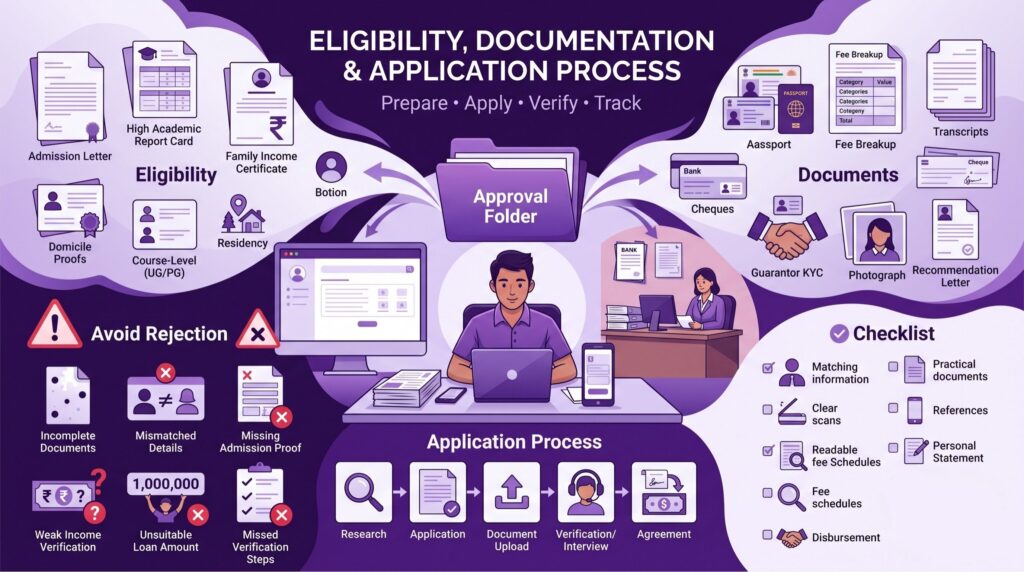
Eligibility requirements: These are the common criteria of eligibility (income, academic merit, domicile, course level)
The provider determines eligibility, but criteria usually include:
Opening the course: Evidence of being accepted into an approved program of study (domestic or foreign).
Academic pedigree: A minimum academic score, appropriate entrance exam rank or qualification for the course selection — some trusts emphasise merit.
Financial need/income ceiling: Many interest-free schemes target students from economically weaker sections of society; in such cases, family income certificates or IT returns may be needed.
Social category or domicile: State scholarships and some trusts require state domicile or focus on SC/ST/OBC/minority students.
Low-income and underprivileged students: Some restrict aid to only those from poor/rural/under hierachy backgrounds.
Age and course level: Some programmes are restricted to undergraduate, vocational, or postgraduate students; others focus only on research scholars.
Residency and verification: Local or rural-oriented schemes may require village-level verification and/or community references.
Demand-based issues: CSR and corporate-funded loans may focus only on courses that are associated with good employability.
Required documents and tip checklist for faster approval
Typical documents checklist:
- Admission/ offer letter with fee breakup
- Identity proof: Aadhaar, PAN, passport or voter ID
- Proof of address & domicile certificate (if applicable)
- Records: mark sheets, entrance scores, transcripts
- Age, proof of countable income, including salary slips, Form 16, copies of IT returns and BPL or income certificate
- Your bank passbook or a cancelled cheque for the disbursal.
- Study Visa and Application Signed Form; Passport-size photographs
- ID of the Guarantor, and proof of address and KYC documents for co-signer
- Security documents (if applicable): titles, FDR receipts
- Write letters of recommendation/reference (for trust / the NGO)
Tips to speed approval:
- Have scanned copies (PDFs) of all documents ready, with matching signatures.
- Include a distinct fee schedule and breakdown from the college —many lenders pay directly to the school.
- Write a brief personal statement about need, plans for the future and intent to repay
- Provide references from school teachers, employers or local community leaders to reinforce trust.
- Ensure document sizes fulfil the requirements and match the formats required for online portals.
Step-by-step online and offline application flows
Online application flow:
- You have to research and then create a shortlist of schemes/platforms (government portals, bank pages, NGO websites)
- Create an account and fill in the pre-application form: personal details, course details (intended subject and level), and some financial information.
- Upload only the above-mentioned documents as scanned copies, and ensure the admission letter and fee breakup are readable.
- In effect, if you have to provide Guarantor/co-signer details & upload their KYC
- Make application; record your candidacy number and wait times.
- Check for email/portal messages; several organisations will ask you for a brief interview/verification call.
- Upon approval, sign the loan agreement digitally or on paper, and funds will be released in accordance with the Loan terms.
Offline application flow:
- Collect the application form from the bank branch, NGO office, or the trust HQ.
- Fill out the application form neatly, then attach photocopies and originals for verification.
- Write an application and attach a personal statement and references.
- You may then be required to submit the data; a local officer may verify it or require a guarantor to be present.
- Execute the loan deed and, if required, provide collateral or a guarantee.
- The funds are disbursed typically as cheques to the institution or through a bank transfer.
Common reasons for rejection and how to avoid them
Reasons for rejection:
- Incomplete or inconsistent documentation (names/address mismatch)
- Using an institution and not presenting proof of admission
- Poor income verification or suspicion of forged documents
- Request for a high loan amount without appropriate collateral or co-signer
- Poor communication, or not turning up on interviews/ verification visit
- For working applicants – defaults in the past or a low credit score
How to avoid rejection:
- Check all documents for consistency and originality of signatures.
- Submit a strong personal statement and 2 reference letters
- If the full fee is large, ask for a smaller loan first that aligns with provider caps
- Disclose income and repayment ability — conceal the facts and your application will be rejected.
- For loans needing guarantors, make sure co-signers understand their legal responsibilities and provide clean KYC.
Practical application tips
Submit multiple applications for no-interest and very low-interest loans in parallel (trusts, CSR funds, Bank concessions).
Maintain both electronic and hard copies of all submissions and acknowledgements.
Proactive follow-ups: NGOs and CSR desks are generally prompt to respond but benefit from polite, timely reminders.
Utilise school financial-aid workplaces: many colleges maintain trust databases and have approved bank tie-ups.
Specify currency and disbursal terms for study abroad applicants: Once you set your country of interest, some organisations hesitate to fund international tuition fees without solid placement or scholarship guarantees.

Comparison: No Interest Loans vs Subsidised Loans vs Scholarships vs EMIs
Cost comparison over loan lifetime (example scenarios)
Assumptions Scenario: Student takes a loan of INR 5,00,000 for 5 years.
Zero-interest student loan: Principal = INR 5,00,000. Total repayment = INR 5,00,000 (fully zero interest and no fees). Principal EMI for 60 months = ₹ ~8333 monthly
Subsidised loan (interest paid during study; post-study interest 8%): Interest during study (2-year moratorium) may be paid by the government; after the moratorium, interest accrues at 8% on outstanding principal. Over 5 years, total cost increases by interest—significant depending on deferment and compounding.
Regular education loan (10% rate): EMI on 5,00,000 at 10% over the period of ~INR 10,624 for 5 years; Total repayment = INR 6,37,440 (interest: 1,37,440)
Scholarship: If a full scholarship covers tuition, you may not need to borrow; cost = zero repayment, but scholarships are limited.
Key takeaway: No-interest loans reduce the overall price, but you must factor in administrative fees and limited coverage. Subsidised loans help eliminate short-term burden but may cost you more in the long run. EMIs on traditional loans lead to much higher lifetime costs because of the interest you pay.
Pros and cons for students and parents
No interest loans:
Pros: Lowest long-term cost, easiest to calculate the repayment amount, less worry about interest accumulation.
Cons: Limited amounts, rigorous qualifications in some cases, requires on-time repayment of principal, processing fees per application.
Subsidised loans:
Pros: Less short-term pressure (interest paid while in school), more widely available through banks, government-sponsored.
Cons: Interest may accrue later; the total cost can remain high.
Scholarships:
Pros: No repayment; a major financial benefit when received.
Cons: Very competitive and not always available; funding may not cover living costs
EMI-based education loans:
Pros: Larger amounts available; banks provide long tenures and standard processes.
Cons: Total repayment can be much more due to interest; families may be tied down for years.
Tax implications under Indian law (Section 80E, taxability of benefits)
Section 80E: Deduction will be available up to the total amount of interest paid in the previous year on an education loan taken for higher education (for self, spouse or child or a student for whom the taxpayer is the legal guardian) under Section 80E (the principal repayment of such loans is not eligible). Since interest-free loans pay no interest, or only a negligible amount, they do not qualify for Section 80E benefits.
Taxability of benefit: If a loan is actually forgiven or converted into a scholarship/grant, the tax treatment depends on the nature of the benefit; under Indian law, scholarships for studies are generally tax-free, subject to any applicable exceptions. Education assistance paid or reimbursed to employees by employers is generally a taxable fringe benefit unless exempted. NGOs giving out loans free of charge, or forgiving them, would also be liable for tax if the loan were treated as income; however, bona fide scholarships and grants meant primarily to further education are not taxable.
Advisory note: Contact a tax advisor, especially for complex employer-funded or loan-forgivable arrangements.
When to pick an interest-free loan vs a scholarship vs an education loan
Choose an interest-free loan if:
You meet eligibility and need partial or full funding with minimal cost.
The required amount is below the trust or programme cap, and you can repay it.
You want principal-only repayments at a predictable rate and less bureaucracy.
Choose scholarship if:
You are eligible for merit- or need-based grants covering most costs—always opt for scholarships, as you don’t have to repay them.
Choose a conventional education loan if:
You have larger needs (e.g. higher-cost foreign college) that exceed what is available interest-free
You need long tenures and structured EMI support; then get the lowest interest rate possible, find a government-aided option, or choose a tax-benefited solution.
Consider hybrid approaches:
Use a full scholarship, interest-free partial funding (trusts/CSR), and a smaller bank loan to cover any shortfall—this approach reduces interest exposure while still maintaining the Section 80E benefit on the interest component of the bank loan.
Top Interest-Free Programmes, Trusts and Platforms to Consider
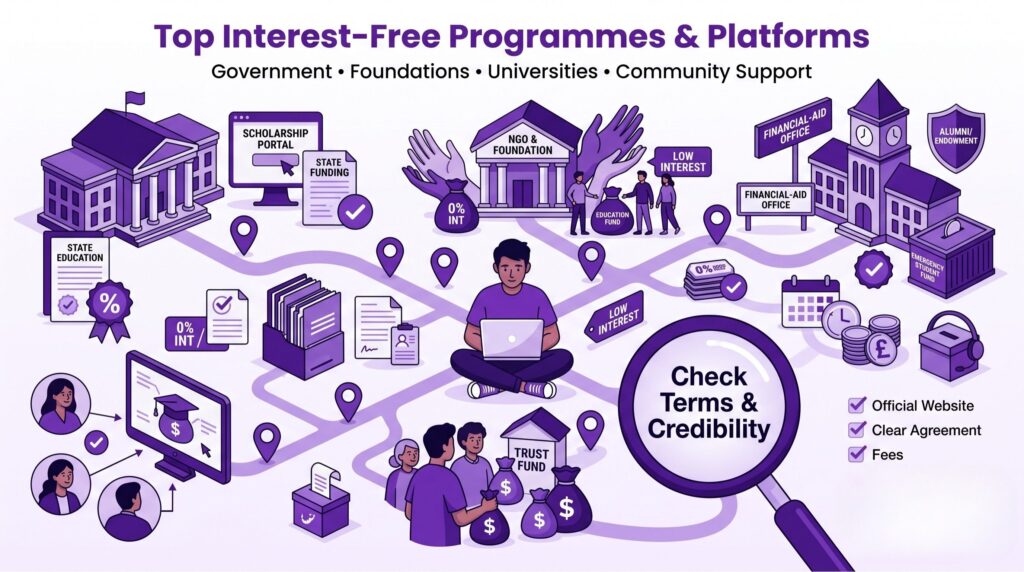
National and state government initiatives to look for
Central / State Scheme: Track centralised portals like the scholarship national portal, alongside announcements from state education departments. Every so often, governments announce schemes related to emergency education funds, merit-cum-need scholarships, and interest-subvention programmes that can function like a temporary interest-free loan.
State education funds: A few states still offer low-interest or interest-subsidised funds for certain categories; you can find them on your state education department and/or Chief Minister Scholarship portals.
University-affiliated funds: Sometimes, public universities will set aside internal funds to help low-income students afford rent.
Major NGOs and foundations that provide interest-free loans (what to expect)
Educational trusts and national foundations: Most well-established foundations have student loan programs with no interest or low administrative fees. Specifically, they typically focus on specific courses with clear outcomes, such as STEM, medical, engineering, and other professional areas.
District-level trusts, religious boards, and local philanthropists provide interest-free help to poor students in rural areas—small sums are easy to confirm and, for the most part, secured at the community level.
What to expect from NGOs:
Submitting through local or internet forms.
Need to document the needs and have references from the communities.
Counselling, mentoring and placement support in some of the programmes
Repayment is typically through monthly amounts, and defaults are often handled through community-level pressure rather than legal action.
University / college-sponsored student support programmes
Institutional aid offices: Most universities run emergency funds, short-term interest-free loans, or deferred fee schemes for incoming students who suddenly face a family crisis that threatens their ability to attend.
Alums and endowment funds: Some universities with active alumni networks may use donated endowments to issue interest-free loans that students repay into the same fund.
Placement-linked funding: Some institutions offer an interest-free advance repayable once campus placement/internship income begins.
How to access:
Contact the college financial aid or student affairs office early — funds are often limited, and application timelines are short.
Notable P2P and fintech platforms offering low/zero interest short-term aid
Crowdfunding platforms: Established crowdfunding portals for education-based causes with commitment-based, interest-free loans or donations
P2P and fintech lenders: Some fintech start-ups and P2P platforms can underwrite short-term, zero-interest loans for admissions, deposits, and exam fees by partnering with CSR sponsors or donors through a grant pool. These are usually restricted to small ticket sizes and short tenures.
What to watch for:
- Platform service charges and disbursal timelines.
- Standards of verification and reputation checks
- Donation vs. loan funding (repayment means repayment)
Examples and how to choose:
- Find platforms that have partnered with vetted NGOs when possible, along with defined success metrics.
- Choose platforms that pay institutions directly (less chance of misuse) and have repayment terms you can document.
How to research credible programmes
Look for clear terms, processing fees, and grievance mechanisms on official websites and published FAQs.
Ask your university financial aid office, placement cells and alums groups for recommendations.
Request sample loan agreements and evaluate processing fees, tenure & recovery clauses.
Prioritise organisations that are legally structured, have clear reporting processes and communication points.
Practical shortlist to start your search
Government Scholarship Portals and State Education Department Pages
Large national foundations delivering loans for education (search by name for current schemes).
Central and state universities (or university financial offices).
Local trusts and NGOs recommended by school, college or community leaders
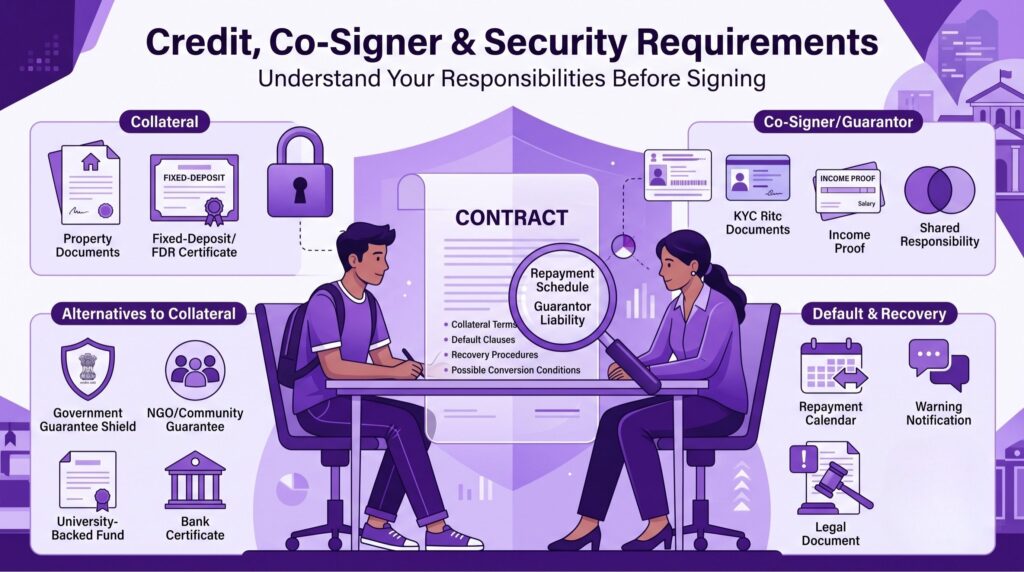
Credit, Co-signer and Security Requirements Explained
When collateral or a guarantor is required
Collateral requirements: Large loan amounts—especially for international tuition or professional courses—often trigger collateral or security requirements. Banks and formal lenders typically require mortgageable property or fixed deposits as security when loan amounts exceed set thresholds or when the borrower lacks an established credit history.
Needs guarantor/co-signer: Most interest-free trust programmes and community loans require a guarantor. Even student bank concession schemes may require a parent as a co-signer. Normally, guarantors must pass KYC and address verification and are legally responsible for repayment if the borrower defaults.
Co-signer responsibilities and legal implications in India
Legal liability: A co-signer/guarantor signs and legally guarantees that, if the borrower defaults, the loan will be repaid. This may also affect the guarantor’s credit history, and they may face recovery action.
Documentation: If you have a guarantor, they must provide proof of identity, proof of address, income details, and sometimes property papers. They may also have to sign the loan deed and undergo credit checking.
Practical implications: Understand the repayment schedule and the consequences of default for guarantors. Obtain copies of the loan agreement and contact the lender if payment is required.
Alternatives to collateral (third-party guarantees, bank certificates)
Third-party guarantees: Establishments like NGOs and community organisations, or even a university-backed guarantee fund in certain areas of the world, can provide an alternative to collateral with significant credibility without requiring property.
Bank certificates/FDR: FDR receipts held in the name of a student or their guarantor could be mortgaged as collateral security; simpler than mortgage registration.
Government guarantee schemes: Lending with government-backed guarantee programmes. These schemes provide partial coverage to banks, along with lower collateral requirements for students who can prove their creditworthiness.
Personal ties and joint affidavits: Letters from the community or sincerely sworn testimonies could also be accepted for small amounts in community-supported models.
How interest-free schemes treat defaults and recovery practices
Charity and NGO programmes: Most trusts prefer to recover funds through a collaborative approach (via counselling, renegotiation, or community pressure) rather than adversarial legal measures. Defaults may halt additional assistance for a short time and might restrict future financing availability.
Institutional recovery: If the institution facilitated disbursal, it may retain transcripts or delay issuing certificates until the loan is repaid.
Interest-free loans handled by the bank: Where a bank is involved and the loan has a legal underpinning, default would expose the borrower to standard recovery actions—reminders, legal notice, invocation of guarantor liability, and eventual recourse through legal recovery or seizure of assets where permissible.
Conversion clauses: Interest-free agreements are often not only interest-free but also include clauses allowing conversion into interest-bearing loans after prolonged default, so review loan agreements to identify triggers.
Practical advice:
Always communicate with lenders; most will renegotiate if you let them know you cannot pay.
Maintain documentary evidence of hardship and formally defer instead of defaulting in silence.
As a guarantor, discover when repayments are being made and keep copies of any correspondence.
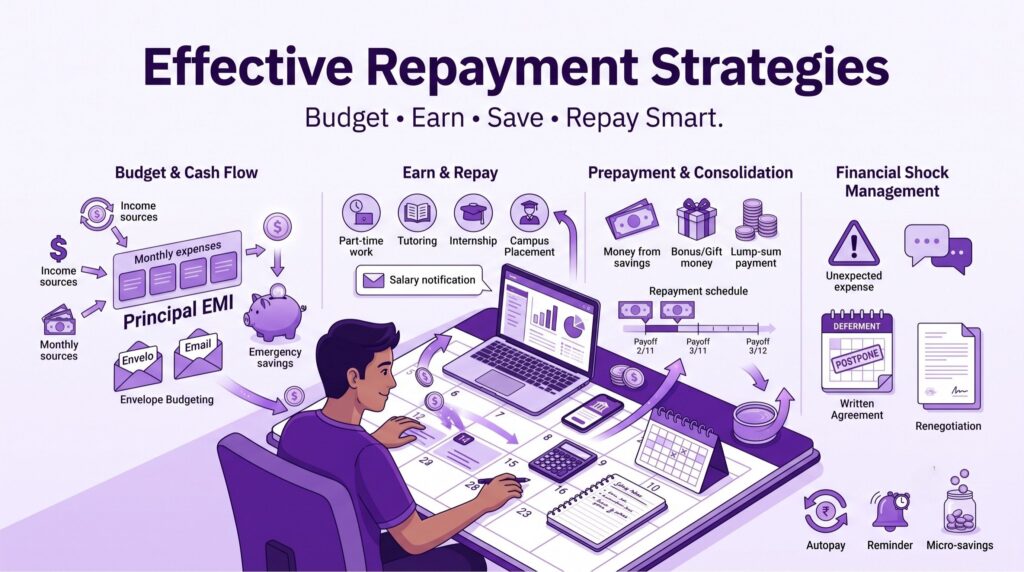
Effective Repayment Strategies for Interest-Free Loans
Students and families: budgeting and cash-flow planning
Develop a basic cash-flow scenario for the month: List expected income (family support, part-time earnings, stipends) and fixed obligations. Allocate a fixed principal repayment amount each month.
Prioritise emergency funds: Create a small reserve to help you avoid missing payments due to unforeseen expenses.
Envelope budgeting or digital apps: Track where your income goes and adjust discretionary spending to meet repayments.
Using part-time work, internships and campus placements to repay
Part-time jobs and internships: Many students can do part-time work, tutoring, or campus internships that can cover their monthly repayments. Look for opportunities that fit around your study schedule and provide constant income.
If you get a campus placement with a fixed salary, pay the maximum principal repayment in the first few months to reduce tenure.
Refinance, consolidation and voluntary prepayment options
In certain scenarios (such as an interest-free loan with a short tenure, as opposed to any other conventional loan you may take on later), refinance or consolidate only if it lowers your monthly outgo/total borrowing cost. In most cases, restructuring an interest-free loan into a conventional option isn’t recommended unless you want repayment flexibility.
Prepayment voluntarily: Many interest-free programmes allow lump-sum prepayments without penalty—use bonuses, gifts or savings for early payoff.
Consolidation strategy: Consolidate multiple small interest-free loans into a single manageable schedule only if the aggregator (e.g., university fund) offers better terms and simpler administration.
Handling financial shocks: moratoriums, deferment and renegotiation
Communicate early: If you are in trouble, call the lender—but very few (if any) NGOs and CSR funds will agree to revised schedules.
Request formal deferment: Find out whether it is part of your scheme so you can get written confirmation of a new formal agreement.
Use documented moratorium clauses: Know if and when moratoriums apply (unemployment, illness, etc.). Negotiate a moratorium, but if it’s not explicit, get it in writing.
Avoid informal promises: Request formal written amendments to the loan terms; relying on oral agreements is dangerous.
Behavioral tips
Manage it well by using autopay where possible to avoid missing payments, especially on fixed monthly debits.
Use micro-savings apps for a repayment cushion—small, regular savings reduce default risk.
Create a debt service calendar with reminders linked to anticipated cash inflows (grants, salaries).
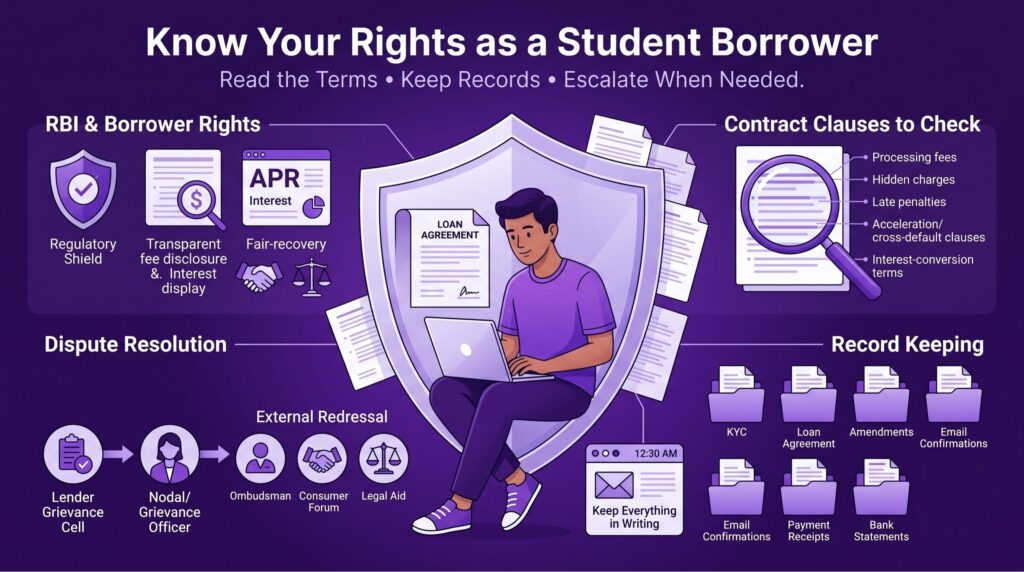
Legal, Consumer Protection and Regulatory Considerations
Rights under RBI regulations and banking grievance redressal in India
RBI Oversight: Student Loans by traditional banks and NBFCs are regulated by the RBI. This includes borrowers’ rights to transparency in loan terms, mandated disclosure of fees, and fair recovery practices.
Ombudsman and grievance mechanisms: If a bank or NBFC violates terms, first approach the bank’s grievance redressal cell; if the complaint is not resolved, move to the nodal officer of the concerned bank; as a last resort, file a complaint with the Banking Ombudsman.
Non-banking entities: By the RBI’s definition, NGOs and trusts are not banks, but they have their own recourse mechanisms, which may differ from institutional policy to civil law. That said, borrowing rights still exist under general consumer protection laws.
Contract clauses to watch: processing fees, hidden charges, penalty clauses
Processing & Administrative fees: Check whether they are deducted upfront or added to the principal. Sometimes these fees are non-refundable, so know what to expect and whether you can cancel them.
Other hidden charges: Watch for annual maintenance charges, account closure fees, or transfer fees for overseas disbursals.
Interest-free agreement: Look for late-payment penalties and whether they could convert to interest-bearing status.
Acceleration and cross-default: Check whether the lender can accelerate repayment after any single default or declare a borrower in Cross-Default across multiple funding lines.
How to escalate disputes (bank ombudsman, consumer court, legal aid)
Step 1: Resolve the internal grievance—submit a written complaint to the lender and retain evidence of acknowledgement.
Step 2: Nodal officer/escalation–Transfer to the nodal officer/Grievance officer for NGOs, if not resolved within a stipulated time frame.
Step 3: External redressal—Banking Ombudsman (for banks/NBFCs), consumer forums, or local legal services clinics.
Legal aid: Public legal service authorities and law school clinics often help low-income students with loan disputes at little or no cost.
Record-keeping and documentation to protect student borrowers
Keep records of: Credit application, KYC, acceptance letter, loan contract, and any amendments (for example, disbursement schedules and repayment receipts).
Email confirmations: Avoid earlier verbal commitments and always prefer written email confirmations. Keep WhatsApp or email records of conversations.
Payment receipts: Always request a formal receipt for any repayments and file them securely.
Secondary evidence: Take screenshots of bank transactions and keep stamped bank statements showing you paid on time.
Audit: Good documentation supports your case if a dispute arises, can help with referrals to the ombudsperson, and may show reasonable efforts to renegotiate terms.
FAQs
Can I get a no-interest loan for studying abroad?
Yes, but more rarely for full-course coverage. CSR programmes, certain trusts, or university-linked funds typically provide short-term (admission deposits/visa fees) interest-free/zero-per cent support for various study-abroad purposes. Most international tuition fees are far too steep for traditional education loans, partial scholarships, or even employer-sponsored programs. If you are looking for interest-free foreign funding, target CSR-enabled or foundation programmes that specifically mention studying overseas.
Are interest-free loans taxable in India?
Loans are not taxable income (unless the loans are forgivable loans). As a rule of thumb, interest-free loans where the interest accrued on the loan is waived or written off (with conditions attached) may invite further tax implications, depending on whether such forgiveness is classified as income or a scholarship/grant. In India, education scholarships are tax-free if they meet the exemption conditions. For complex cases (employer-provided education assistance, forgivable loans), connect with a tax advisor for clarity on Section 80E and related provisions.
What happens if I default on an interest-free loan?
NGOs/trusts frequently pursue recovery through seminars and local pressure; for formal entities like a bank, legal recovery proceedings and guarantor proceedings are possible. Some contracts allow conversion in case of default in terms of interest-bearing loans or penalties. Always reach out early, formally request deferment and keep track of the hardship.
Can I convert a regular education loan to interest-free status?
Very few loan cases convert a regular education loan with the bank into a permanent interest-free loan. To convert a loan fully, you typically need to qualify for temporary interest subvention or a study loan under a government scheme (which makes it, in effect, interest-free for that period). Still, this conversion doesn’t necessarily happen without lender consent. Some trusts may refinance part of an existing loan by paying off principal and replacing it with an interest-free arrangement, subject to lender cooperation.
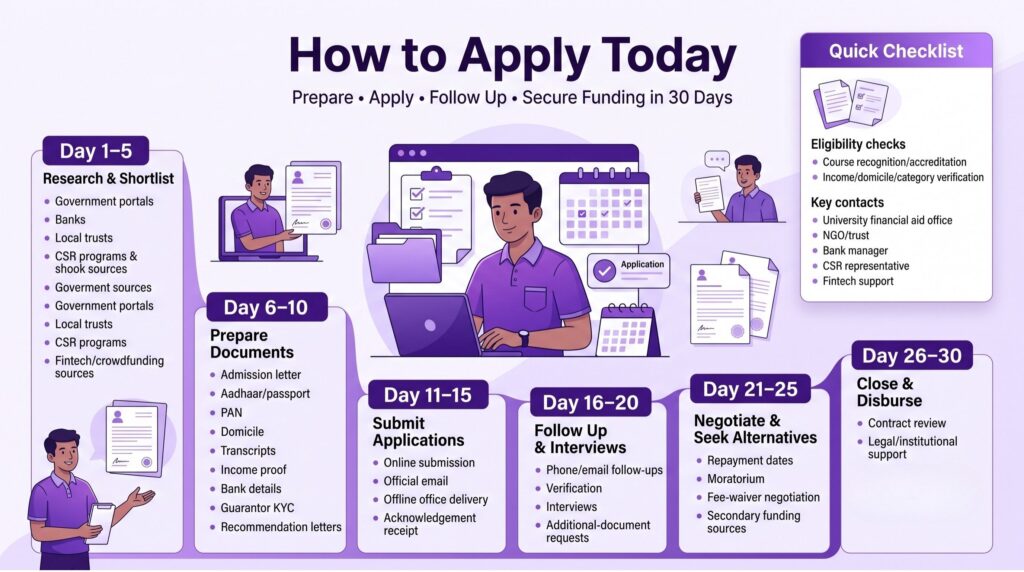
How to Apply Today — Checklist and 30-Day Action Plan
Quick checklist (documents, eligibility, contacts)
Documents:
- Admission offer letter along with fee breakup
- ID proof (Aadhaar, passport), PAN number
- Address/domicile certificate
- Academic transcripts/entrance results
- Proof Of Income (Form 16/ITR, Salary Slips) or income certificate
- Bank Account Details And Cancelled Cheque
- Photo and a signed form in passport size
- Guarantor KYC, and if needed — consent
- Recommendation letters (teachers/employers)
Eligibility:
- Check the recognition of the course and accreditation of the institute
- Income checks, domicile and category verification
Contacts:
- University financial aid office
- NGO/Trust offices at Local Level & Branch Manager of the Bank
- Relevant contact person (CSR) within the correspondent companies
- Fintech platform support email/helpline
30-day step-by-step plan: research, apply, follow-up, appeal
Day 1–5: Research and shortlist
Identify 5–7 target sources: government portals, bank offers, 2 local trusts, 1 CSR program, 1 fintech/crowdfunding platform.
Collect contact information and application windows.
Day 6–10: Prepare documents
Scan and convert documents to the required formats; prepare a personal statement and two recommendation letters.
Request income certificates and guarantor consent.
Day 11–15: Submit applications
Submit online if possible, then deliver offline to local NGO/bank offices.
Use official email for submissions and request acknowledgement.
Day 16–20: Follow-up and interviews
After 3 working days, follow up by email/phone; conduct short interviews and verification visits.
Provide additional documents quickly when requested.
Day 21–25: Negotiate the terms, seek alternatives
If approved partially, negotiate moratorium, repayment dates or fee waivers.
Apply for any remaining gap through secondary sources (crowdfunding or a university fund).
Day 26–30: Closing deals and disbursements
Read the loan terms and seek legal or institutional support if the terms seem unfavourable.
Sign and secure funding instructions to your college/institution.
Interview and reference letter tips
Interviews: Explain why you need the funding, your repayment plan, and your placement options. Carry original documents and a cool mindset.
References: Ask referees to mention your reliability, character, and employment potential. Employer references should state the role, duration, and salary, if applicable.
Building Credibility: How Students Can Improve Chances
Academic and extracurricular evidence to strengthen applications
Provide transcripts, entrance ranks and proof of consistent performance.
Include extracurriculars that highlight dedication or leadership skills and experience managing time = volunteer work, competitions, club leader?
Mention your coursework, internships or research experiences relevant to the field of your choice.
Reference letters and employer proof for professional courses
Give two solid references — one from an academic (teacher/professor) and the other from a workplace experience (internship supervisor or job employer).
Candidates who are working and need to provide proof of income: salary slips, an employment offer letter, and a letter from their employer stating intent to keep them on board for the duration of the course, or a letter supporting their continuing education.
Credit history and small steps to build trustworthiness
If you or a family member doesn’t have a good credit history, build positive financial footprints: keep a savings account and deposit small amounts frequently, use a padded credit card or a personal loan, and repay on time.
Take care of credit reports: Request a copy and remove any errors before applying.
Using community references and social proof in India
For rural applicants, local credible references can include community leaders, local MPs/MLAs (if appropriate), and recognised NGO workers.
Get key endorsements from college faculty or alumni — use your alumni networks to make introductions with trusts and CSR officers.
Document volunteer or community service hours—this social proof reassures philanthropies about your character and commitment.
Conclusion
Interest-free student loans in India are a powerful option when available, particularly for targeted short-term needs and for students from economically weaker backgrounds. Combining careful research, strong documentation, and proactive communication with lenders increases your chance of securing such funding. Keep multiple parallel options open—scholarships, interest-free support, and low-interest bank loans—to construct the most cost-effective funding package for your education goals.