
Download StuCred.
The Real Time Student Credit App.

Instant Personal Loan for Students in India — Complete Guide
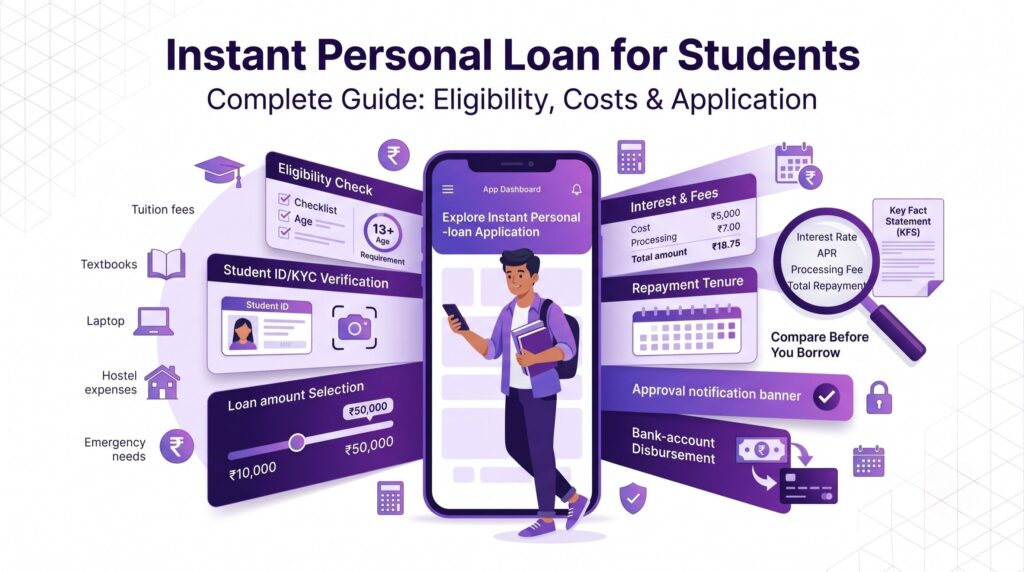
Accessing quick funds for study-related needs has become easier in India. This guide explains instant personal loans for students — what “instant” truly means, the loan types available, eligibility, documents, top lenders, application steps, costs, risks, real-life examples, and practical tips so you can choose the right option for college fees, travel, or emergency expenses.
Who this guide is for & what “instant” really means
Student profiles covered
UG (Undergraduate): Campus & Distance learners, short-term funds like tuition fees, hostel fees, Laptop purchase/travel.
PG students (master’s, MBA, or research students) need higher fees or research-related expenses.
Students Who Work While Studying: Loans for those earning part-time or internship money; they can be placed at a higher loan amount level, with faster salary approval.
Exchange/abroad aspirants: Students who have plans to study abroad but need immediate, bridging finance for application fees or visa, travel deposits or rent/security deposit
This guide is for families or students in India looking for “instant” / fast finance options—faster education-related liquidity without long waits for bank-sanctioned education loans.
Definition of “instant” vs. fast/priority processing in India
Instant (in terms of fintech/NBFC): Pre-approved, online and e-KYC with minimum documentation; sanction and disbursal in minutes to 48 hours. Often marketed as “3-minute applications” or “instant disbursal”.
Fast/priority bank processing: Conventional banks can offer selective student strategies or retail individual loans that complete sanctioning within 48–72 hours, but disbursal may take a couple more days (due to paperwork and internal approvals).
Practical reality: With co-borrowers with solid credentials, app-based NBFCs and fintech lenders often have truly instant disbursals when the borrower is pre-approved. Banks can offer lower rates, but typically with slower timelines.
Typical eligibility, sanction and disbursal timeframes to expect
Eligibility checks (online): Immediate via Aadhaar e-KYC, PAN validation, and credit bureau lookups — takes minutes.
Sanction decision: For pre-approved fintech offers or NBFC products, the decision can be instant; for banks or non-preapproved cases, expect 24–72 hours after you submit documents.
Disbursal: Instant apps can disburse money in minutes to a few hours, while banks may take 2-5 business days. That deadline is faster if the co-borrower provides signed consent or an e-sign.
Tip: Keep digital copies (Aadhaar, PAN, admission letter, fee bill) so you can turn around quick sanction into near-immediate disbursal.
Read more
Types of instant personal loans students can get
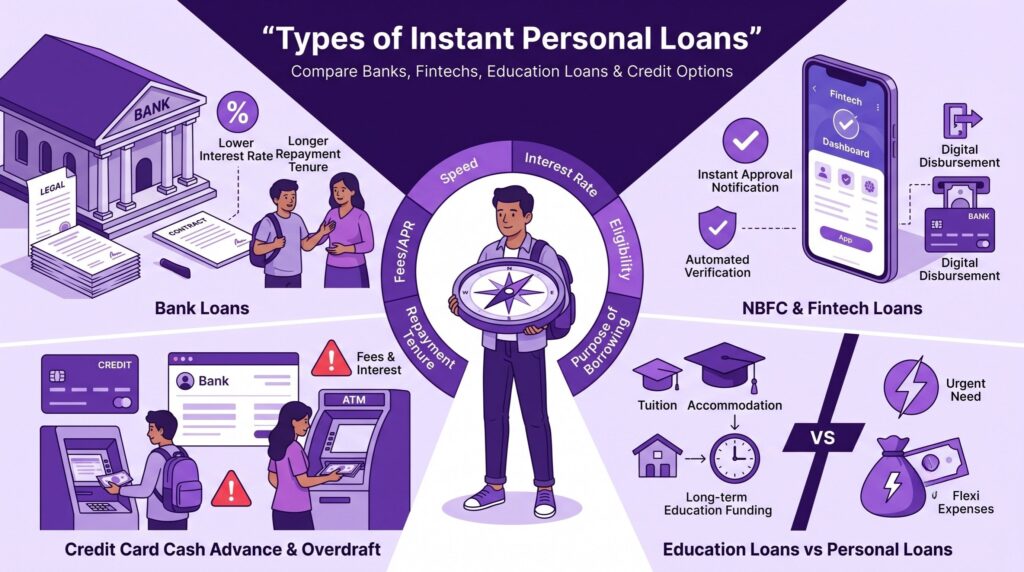
Bank personal loans (student-focused schemes vs. retail loans)
Student-centric bank schemes: Some public and private banks offer dedicated student education loans or student personal loans with benefits such as lower interest, moratorium until course completion, or flexible collateral rules. These often require documentation proving admission and information about parents or a co-borrower. Processing speed varies; larger banks may have efficient “student loan” verticals that speed up sanctioning once documents are verified.
Retail personal loans from banks: If a formal education loan is not selected, the student (along with a parent or co-borrower) may prefer unsecured personal loans for fees or emergencies. Although retail personal loans have transparent fee structures and competitive interest rates, big banks require credit history (or a co-borrower) for approval, and application processing usually takes 2–5 business days.
When to choose banks: Choose bank loans when you prioritise lower interest rates, better consumer protection, and longer tenors. If the bank offers an instant student product, you may be processed faster.
NBFC/Fintech instant loans (app-based, pre-approved offers)
NBFCs and App-based fintech lenders provide speed: Automated credit decisions based on PAN, Aadhaar, bank statement analysis and internal scoring/ factors that help you get instant approval and disbursal
Preapproved offers: If you are in the lender’s database (previous customer, salary account, or partner university tie-up), you may be offered pre-approved limits that need only a click-accept option and e-sign to disburse.
Pros and Cons: Higher rates than banks and less transparency on fees; however, they offer a quick process with minimal paperwork. Always compare effective APR and read the T&Cs for EMIs and late-fee structure.
Use cases include immediate semester fee payments, travel deposits, or short-term bridging finance for students applying to study abroad.
Education loans vs. personal loans — when to choose which
Formal education loans: These are typically granted by banks/NBFCs only for educational purposes such as tuition, accommodation, exam/visa fees and other formal matters; these can offer a lower interest rate along with some tax benefits for parents or borrowers (as per provisions), and the repayment tenor tends to be longer. They may take longer and require higher amounts, and they often need documentation such as collateral.
Personal loans: Unsecured loans that can be used for any purpose, including education-related expenses. Faster access (especially from fintechs/NBFCs) and minimal paperwork, but higher interest and no tax benefits.
Decision guide: High need and more permanent long-term funding (eg: full course fees, overseas tuition) – prefer formal educational loans. If you need an urgent small amount for immediate expenses (such as semester fees, travel, deposits): instant personal loans or fintech instant education loans are a good choice.
For speed, primarily choose NBFC/fintech instant disbursal.
If cost and repayment flexibility are vital: pursue an education loan, even if it takes longer.
Credit card cash advance and overdraft options for students
Credit card cash advance: This is an option for students or parents, but it charges fees and high interest; it effectively lets you get cash immediately. Not ideal for lengthy repayment.
Overdraft against savings or salary account: Some banks provide overdraft or overdraft-on-card linked to a student or parent account. Interest can be lower than a cash advance, and no repayment is required, which benefits the creditor only.
When to use: Only when you need liquidity for a very short timeframe that you can repay almost instantly—e.g., an urgent payment due by end of day. Loans with structured EMIs are preferable for bigger requirements.
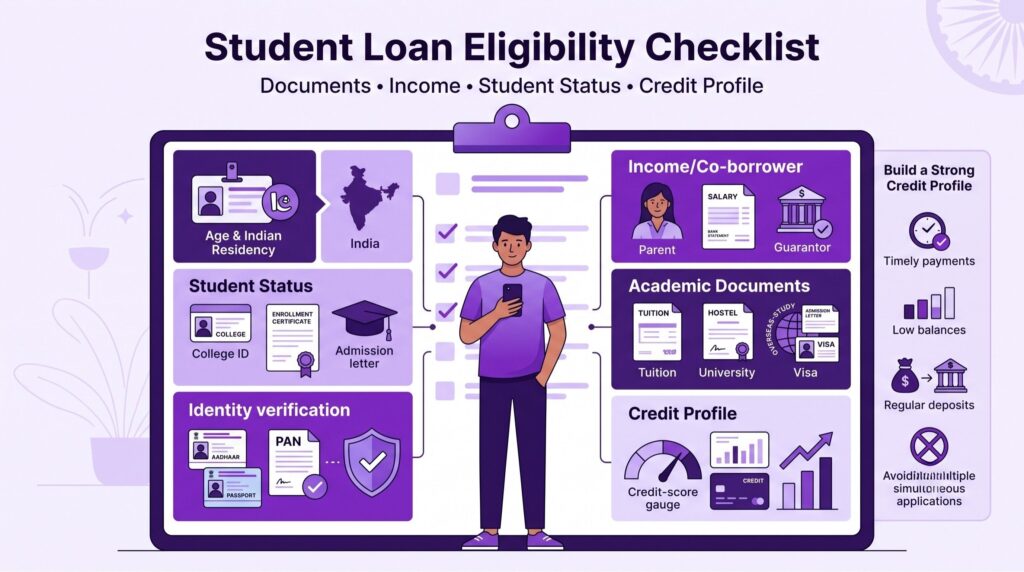
Eligibility checklist specific to Indian students
Age, residency and student status requirements
Typical age range: 18–35 for most instant personal loan products targeted at students; final-year students often accepted if course completion and job prospects are evident.
Residency: You must be a resident in India; some lenders accept NRIs if a co-borrower is an Indian resident.
Evidence of student status: An acceptance letter, student card, university enrollment certificate, or a scholarship/stipend letter to show the course and duration. For exchange/abroad applicants, include admission offer letters & travel timeline.
Income considerations (self, co-borrower, guarantor)
Own income: Working students or interns with a stable flow of money (salary and stipend) have a higher chance of approval; they may ask for bank statements or salary slips if your application is raised.
Co-borrower/guarantor: Parents are the most common co-borrowers—steady income & credit history increase chances of sanction, lower interest rates, and faster disbursal.
No-income: If you are a student with no income but your family has sufficient earnings, you can still get a student loan from many fintech NBFCs by providing your parents’ salary proofs or, in some cases, a guarantor — though rates will be higher and amounts lower.
Minimum income: Varies — fintechs and banks often focus on the co-borrower/guarantor salary profile; the minimum can be as low as INR 10,000–20,000 per month for a co-borrower.
Academic documents and ID proofs commonly accepted
ID proof includes Aadhaar, PAN, passport, voter ID. Aadhaar-based e-KYC accelerates verification.
Proofs for studies: Including study letter, fee invoice, student ID card, proof of enrollment in university or other documents containing the same information regarding your admission to the educational institution (or hostel allotment)
For students going abroad: Offer letter | I-20 (for the USA) / CAS (for the UK) & visa appointment slip or flight booking as per release.
Lenders may accept scanned/photographed documents if submitted via secure lender app or portal.
Credit score expectations & how students can build score quickly
Expectations: To get the best interest rates, lenders prefer a student’s credit score to be 700+. Fintech instant offers may approve lower scores (600–700) at a higher cost,
Building score quickly:
- Be an authorised user on a parent’s credit card or joint-account holder to receive on-time payment history.
- Try a small secured credit card or student credit card and pay the balance in full each month;
- Keep clear bank statements: low overdrafts, regular deposits, and on-time bill payments.
- Don’t apply for multiple loans or cards at the same time, as they can lead to several hard inquiries.
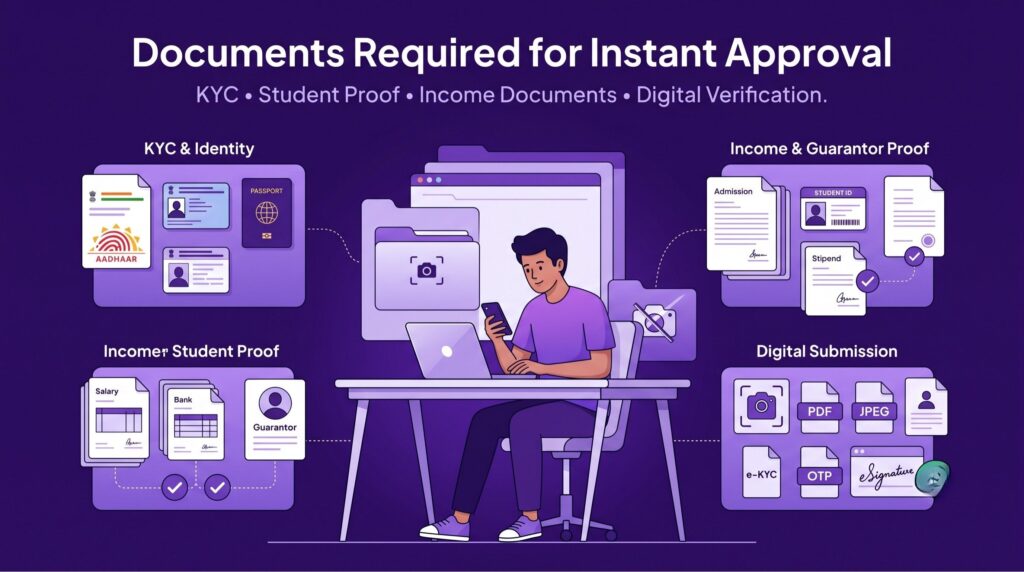
Documents required for instant approval
Minimal KYC documents (Aadhaar, PAN, passport, voter ID)
Aadhaar: Main e-KYC document for instant identity and address verification. Keep your linked mobile number active, as you will receive OTPs here, and e-sign speeds up processing.
PAN: Required for loan approval and tax reporting; upload a scanned e-PAN or PAN card.
Alternate ID proofs accepted by lenders include a passport and voter ID; a passport is especially helpful for students planning to go abroad.
Proof of study and admission letters, fee bills, or stipend
Admission/offer letter [if applicable]: Required to prove the educational purpose for many products meant for students
Fee invoice/receipt: Mandatory for tuition or semester fee-based loans; allows lenders to determine the loan amount as it relates to need
Stipend letter: for working students or research scholars with stipends, as it proves consistent flow of income and thus improves the credentials
Income proof alternatives: parental salary slips, bank statements
Required documents: salary slips (last 3–6 months), Form 16 and employer & HR letter or income tax returns (ITR) increase the chances of approval
Bank statements: Provide only six months of bank statements where salary credits or regular inflows are visible (fintechs rely heavily on bank statement data).
Guarantor documents: Include the guarantor’s identity, address, and income proof if they are used instead of a co-borrower.
Digital document submission tips to speed up approval
Scans or high-resolution photos with no glare and trimmed borders.
Upload documents in lender-required formats (PDF, JPEG) and zip files.
Use Aadhaar-based e-KYC (know your customer) and e-sign to avoid the hassle of sending physical documents.
Verify your PAN and Aadhaar details on the portal before submission to avoid mismatches that cause delays.
Keep original documents on hand for verification after the loan is granted.
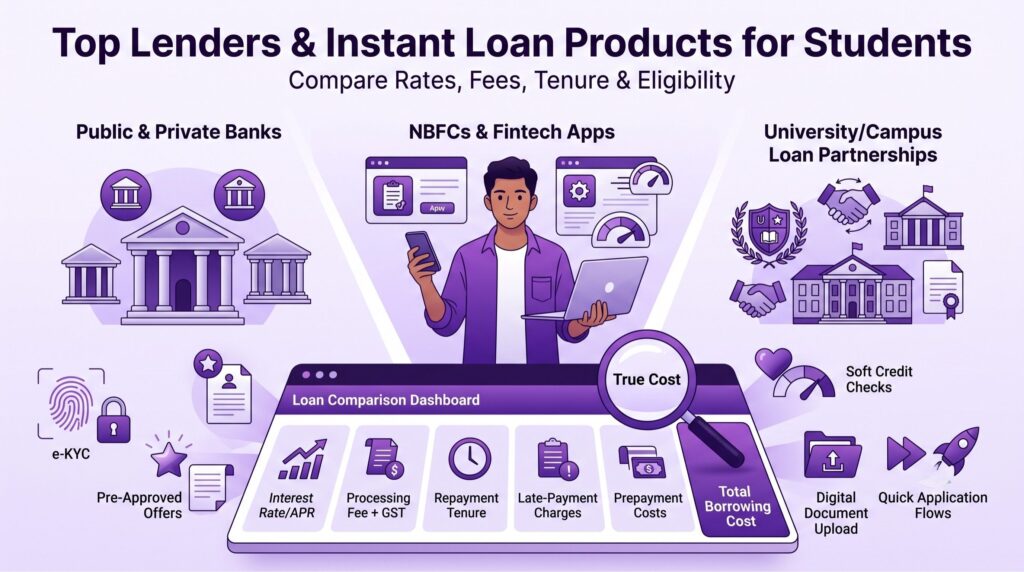
Top lenders and instant loan products for students
Major public/private banks offering fast student-friendly loans
Public sector banks: State Bank of India (SBI) education loans and student-focused schemes may offer competitive rates; SBI Student Loan and SBI Aadhaar-based processes can be relatively quick if documentation is complete.
Private banks: Private Banks that provide tax and Low-interest retail personal loans for students and parents, with faster turnaround for salaried co-borrowers in India, include HDFC Bank, ICICI Bank, and Axis Bank. Such banks typically have online application flows that include e-KYC.
Cooperative and small finance banks: These can be target-specific for student products and local processing rates; check consumer protection and rate transparency upfront.
Leading NBFCs and fintech apps with instant disbursal options
Fintech NBFCs: Many NBFCs partner with apps to offer personal loans with minimal documentation and rapid bank statement evaluation, often promoting “instant personal loan” or pre-approved within a couple of minutes.
Popular fintech: Check for a presence in app stores, how prominently APR is displayed on their app pages, and consumer reviews. They offer an experience of instant approval and digital document upload—what people call a quick student loan app in India.
Campus tie-up: Several NBFC and fintech-based education loan providers enter into arrangements with universities to provide approved loans for students who have secured admission.
Comparing interest rates, processing fees and tenor for students
Interest range: Instant fintech NBFCs charge higher APRs (even the average interest goes beyond typical bank personal loans). You can expect the following spread: banks (lower spread) < NBFCs (higher) < credit card cash advance (high).
Processing fee: A flat amount or a % of the loan (1%–4%) + GST; preapproved fintech offers may have lower up-front fees but higher rates.
Tenor: Student personal loans typically have a shorter tenor (12–60 months). Longer tenor (including moratorium) = up to 10–15 years for formal education loans
Always calculate the effective cost: Include processing fees, GST, advance payment penalties, and late payment charges to arrive at true cost figures you can compare between Bank loans and Instant options.
Where to find pre-approved or 3-minute application products
Bank portals and partner apps: Some banks (like Axis) used to show pre-approval offers via internet banking if you have access to their savings account or credit history.
Fintech marketplace: After a soft credit check (which does not affect your score), loan aggregators and comparison apps give you access to pre-approved offers.
University/college financial aid pages: Campus mergers occasionally give links to pre-approved NBFC offers.
Tip: Only use “soft-check” pre-approval tools to compare offers without impacting your credit score.
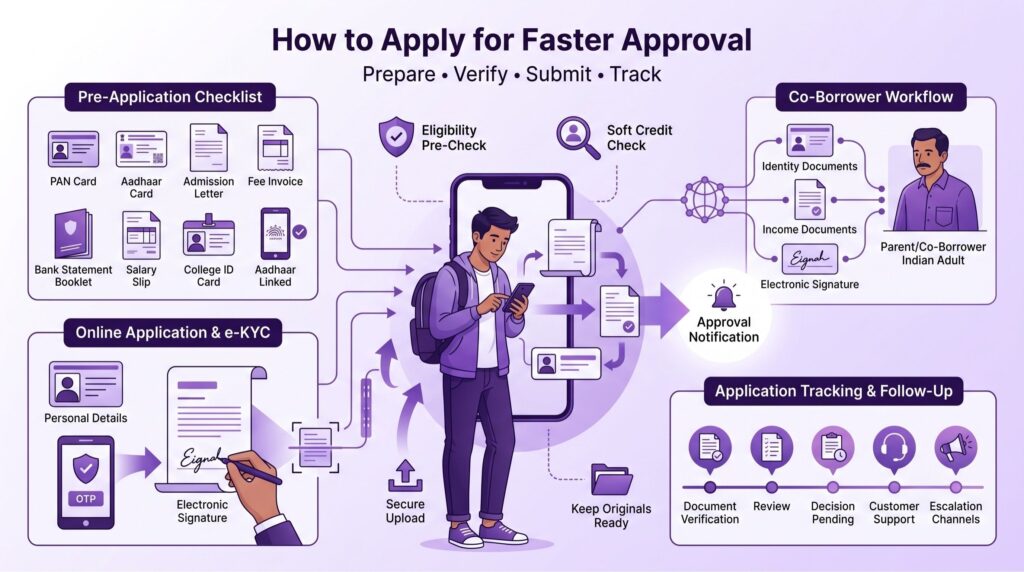
How to apply: step-by-step process for fastest approval
Pre-application checklist and eligibility pre-check tools
Checklist: PAN, Aadhaar, admission letter, fee invoice, 6 months of bank statements (yours or co-borrower), salary slips (co-borrower ITR), student ID, and mobile no. linked to Aadhaar.
Use pre-check tools: Almost all lenders and aggregator sites offer eligibility calculators and soft-check pre-approval, which fairly quickly appraise offers. A soft check across 2–3 lenders can help you find the best instant option.
Filling the online application and uploading e-KYC quickly
Fill in fields properly: Mismatches can cause an uncomfortable situation. Please use the same name and address as per Aadhaar/PAN
e-KYC and electronic signature: Complete your Aadhaar e-KYC and e-sign so you will not have to courier signed forms. Keep your OTP-enabled mobile active.
Upload a clear version of the document: Upload the document in the size/format requested by your lender. Avoid file-format issues by using lender apps that capture directly through the camera.
Using co-borrower/guarantor workflows to speed sanction
Pre-brief your co-borrower (parent): Make sure they carry salary slips, PAN, Aadhaar and a bank account for e-mandate signatures.
Joint e-sign: Most lenders now facilitate co-borrowers e-signing remotely, cutting out the need to drive there in person.
After choosing a co-borrower, choose the one with a better credit score to minimise time-consuming manual verification.
Following up: tracking application, expected SLA and escalation
App/Portal tracking: Both are the primary way many lenders provide status updates. Wait for timelines like instant decision, under review or document verification.
Escalation: If the SLA expires, call customer care, use in-app chat, or write to grievance channels via email. Write to the branch/relationship manager for banks; be specific and include reference numbers.
Keep originals handy: For post-disbursal verification, submitting documents on time clears holds.

Interest rates, fees and repayment options for students
Typical APR range for instant student personal loans in India
Banks: Personal/education loans through banks typically offer APRs between 8%–13% for well-qualified co-borrower-backed cases (education loans may vary).
NBFC/fintech instant loans: APR ranges even higher for most NBFC/fintech instant loans than banks (12%–28%). Rates are based on borrower profile and loan tenure.
Credit card advances: With fees and the interest structure, the effective APR can be 24%–36%.
Always ask for the APR calculation so you can compare apples-to-apples —the effective interest rate.
One-time fees: processing charges, GST, prepayment penalties
Processing fee: Usually 1%–4% of the loan amount or a fixed amount + GST. International and domestic fintech lenders offer all of these options, including first-time discounts or bundled fees.
Other fees: Administrative charges, foreclosure/prepayment fees (rare on individual loans but possible), late payment charges, and cheque bounce fees.
Negotiate: If you have competing offers or a highly qualified co-borrower, ask to have your processing fees waived or reduced.
EMI structuring, moratoriums, and flexible repayment for students
EMI choice: Standard EMI calculators let you choose tenure to balance monthly burden vs. interest cost. Shorter tenors reduce total interest.
Moratorium: Formal education loans usually allow a moratorium until course completion plus an additional grace period; instant personal loans usually don’t offer a moratorium.
Flexibility: Few lenders offer step-up EMIs (that increase from lower to higher over a period), pre-approved EMI holidays, or part-payment facilities. See if these are also available for scholar products.
Cost comparison: short-term instant loan vs. formal education loan
Short- to medium-term instant loan: Higher APR and fees but the fastest; ideal for urgent, small short-term bridging finance.
Education Loan for Studies Abroad: Lower interest, longer term & some tax sops; Slower to process but makes sense if you want funds for the entire course.
Decision hinge: An instant personal loan can be economical when you need urgent funds for a one-off situation (obviously you need to pay it back straight away) to cover a few thousand or a month’s rent deposit. A formal education loan is usually your best friend for full-course fees.
Pros and cons of taking an instant personal loan as a student
Benefits: Speed, accessibility, minimal paperwork.
Quick access: Disbursed within minutes to 48 hours, which helps with urgent fee deadlines or travel issues.
Reduced documentation: Many fintech products now use digital documents and proof of a parent/co-borrower instead of hard collateral.
Accessibility: Students can get a loan with a co-borrower (parents) or from pre-approved brands without credit history.
Risks: higher rates, limited borrower protections, hidden fees
Pricing: Interest and processing fees are higher than for formal education loans.
Consumer protections: NBFCs and fintechs differ in grievance redressal processes versus regulated bank avenues; some small lenders may have predatory practices.
Hidden terms: Prepayment penalties, daily interest on early defaults, and vague late fee policies. Always read T&Cs.
When an instant loan makes sense vs. alternatives
Use an instant loan when:
- You need immediate funds for a deadline (fee cutoff, visa deposit).
- The amount is small, and you can repay easily to save on interest.
- The loan process is too formal and time-consuming, and it requires a good co-borrower.
Avoid if:
You need long-term funding for full tuition, where education loans offer cheaper, tax-efficient options.
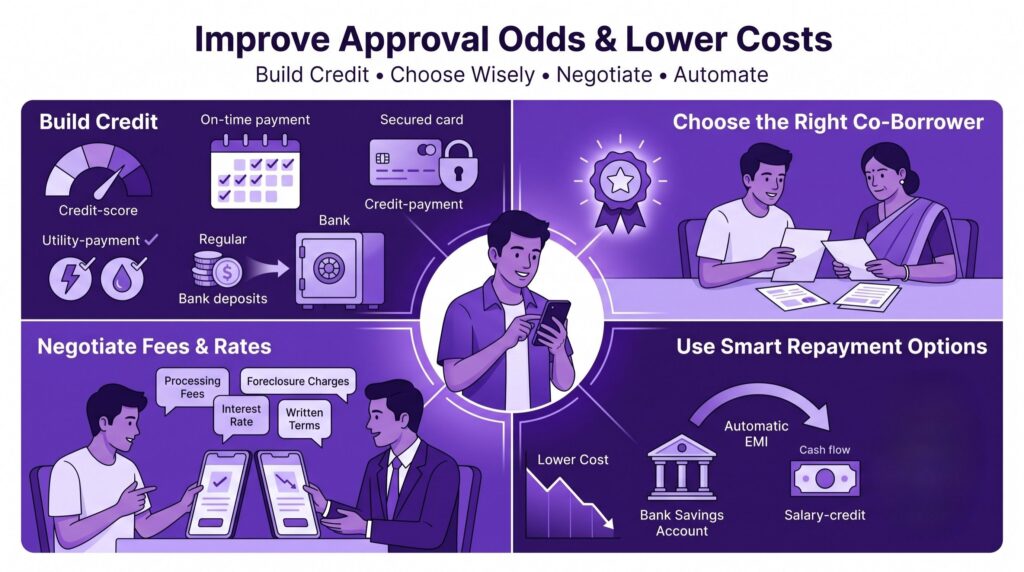
How to improve approval odds and lower cost (practical tips)
Building/repairing credit score quickly (for students)
- Add yourself as an add-on or Joint credit card user on a parent’s account, and make sure every payment is on time.
- Use a tiny secured credit card or micro personal loan and pay it back on time.
- Maintain a bank account that regularly shows money coming in, and avoid bounced cheques to show you are a low-overdraft or no-overdraft user.
- Pay utility bills and mobile EMIs on time periodically; lenders increasingly rely on alternative data.
Selecting a perfect co-borrower or guarantor
Priority: Parents with permanent paid jobs, transferable income and high credit scores.
Alternatives: A partner (as long as they have decent credit) or an immediate family member with a clean credit history.
Avoid guarantors with ongoing high leverage or frequent defaults; they reduce approval odds and raise the rate.
Negotiating processing fees and interest — what to ask
- If you have competing offers or are a long-term banking client, ask for a waiver/get a reduced processing fee.
- Lower rate in return for a shorter tenure or automatic EMI debit from salary/savings account held with the lender
- Ask for transparency about foreclosure fees and request written proof of any agreed terms;
Using salary accounts, automatic EMIs and borrower offers to reduce rate
Link to lender salary/savings account: Banks/fintechs typically offer a (0.25%–1%) reduction in loan rates for customers who keep their salary/savings accounts with the same bank.
Auto-EMI setup: Lenders offer more attractive rates or fee waivers when you opt for auto-debit.
Search for Student-specific offers: Pre-approved offers or campus tie-ups can lead to preferential rates.
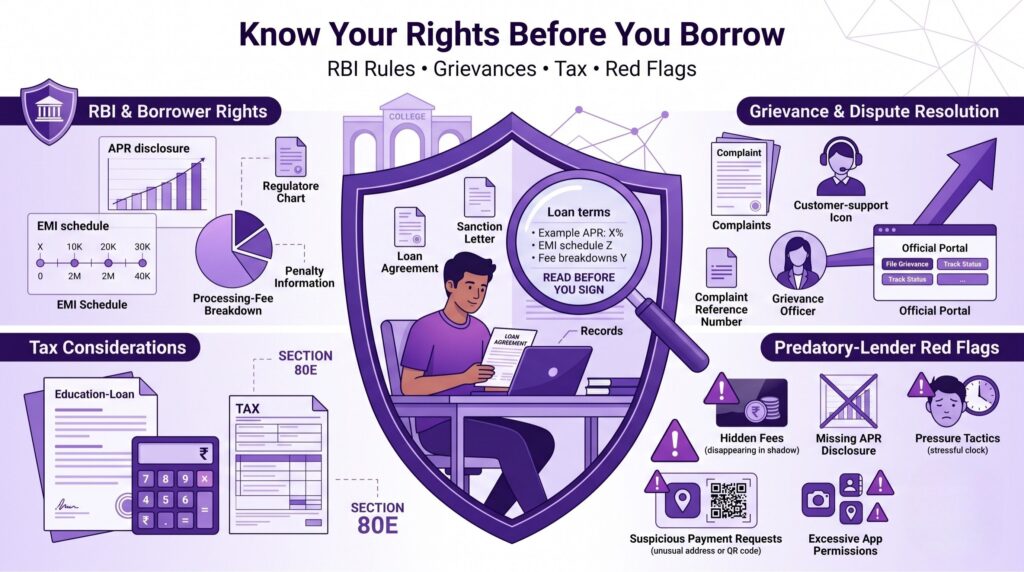
Legal, consumer protection and tax considerations in India
Key RBI rules and borrower rights that affect instant loans
RBI has regulated banks and NBFCs, with fair practice codes applicable to all NBFCs; interest charged must be transparent, with grievance redressal norms.
Borrowers must be given disclosure of APR, processing fee, EMI schedule, and penalties. If unclear, request a written breakup.
If the company refuses to resolve complaints, approach the Banking Ombudsman (for banks) or the NBFC grievance mechanism, and then escalate via the RBI portal.
Documentation and dispute resolution (Banking Ombudsman, NBFC grievance)
Keep copies of all correspondence, sanction letters, and loan agreements.
For other issues, if a grievance remains unresolved, banks have the Banking Ombudsman, and NBFCs have their own grievance mechanisms. All online complaints must first go to a designated grievance officer in the NBFC or bank, then be escalated to the RBI if the grievance remains unresolved.
Keep records of when you sent your complaints and their reference numbers.
Tax implications — interest deduction possibilities (education loan vs personal)
Formal Education Loan: Interest paid on a higher education loan may qualify for tax benefits under Section 80E (subject to extant tax law) – Verify whether qualifying limits have changed.
Personal loans: Interest on personal loans is still generally not tax-deductible for education.
Speak with a tax advisor about your specific situation, especially for loans taken out specifically for studying abroad.
Avoiding predatory lenders and recognising red flags
Red flags: Advance large fees, missing APR disclosure in the terms, pressure tactics, verbal-only agreements and/or handwritten total payments into suspiciously unverified payment methods.
NBFC registration and RBI licensing check: Look for online reviews, and pay attention to app permissions and complaint resolution records.
Minimise risk by using regulated marketplaces and trusted banks/fintechs.
Frequently asked questions (FAQ)
Can final-year or part-time students get instant loans?
Final-year students: Eligible if Admission/fee proofs are available and co-borrower support is provided. Lenders consider imminent employment prospects for sanction.
Students who are studying part-time can also apply (depends on income validation; students with jobs and bank statements and having a fixed monthly stipend/salary have great chances, especially backed up by a co-borrower)
Will taking an instant personal loan affect future education loan eligibility?
It can. A current personal loan increases your credit utilisation and may lower your credit score if you miss payments, which could affect future education loan terms.
If you repay it on time, or if you refinance the EMI through a formal education loan later, it has very little impact.
Is a co-signer always required, and who is a safe choice?
Fintechs don’t always accept student loan applications without co-signers, except at higher rates and for smaller amounts.
Your safe cosigner: Parents with stable jobs, a good credit rating, and an income traceable on paper. To improve approval odds, choose someone with a low existing debt-to-income ratio relative to their total debt.
What to do if application is rejected — stepwise recovery plan
Retrieve rejection reason: Request the lender for a specific reason (credit score, income, incomplete documents)
Resolve problems: Document errors, add a co-borrower, clarify bank statement
Go elsewhere: Be pre-approved with soft checks across other lenders or aggregator channels.
Establish credit: Get a small secured loan or Secured Credit Card, pay on time and apply again 3–6 months later.
Conclusion — next steps
If urgent and the ticket is small: Use pre-approved fintech instant offers after checking APR and hidden fees.
If funding large tuition or seeking tax benefits: Prioritise a formal education loan even if it takes longer.
Always prepare digital documents in advance, select a credible co-borrower, and compare total cost (APR + fees) before accepting instant disbursal.